Calvary Palisades

Summer in the Scriptures

Mobile reader edition for iPhone Safari. Use the day picker or table of contents to jump around.

Table of contents

Day 01

jesus

June 01

Luke 24:13-35 - Seeing Jesus

This is an introduction - yes, to the Bible, but really to Jesus. And getting introduced to Jesus is less like meeting a new acquaintance and more like discovering gravity: everything else only makes sense in relation to Him.

Christianity isn't a self-improvement plan with religious language; it is good news about Jesus - crucified, risen, reigning, and rescuing. It's not "try harder, be nicer, add a little spirituality so you don't spiral." It's a claim about a person, and the whole thing hangs on one question: Who is Jesus?

Maybe that's why you're here. Maybe your current answer is basically, "Uh... good guy?" or "wise teacher?". Either way, you can't do really answer that question without reading the Bible. People have written plenty about Jesus, but Scripture is the source material. Beyond that, we're guessing.

In Luke 24, two disciples walk away from Jerusalem crushed. Jesus is dead, rumors are flying, and then Jesus Himself comes alongside them, but somehow they don't recognize Him.

They unload their disappointment. Jesus doesn't give vague comfort. He gives truth with edge and reframes everything: the cross wasn't a detour or Plan B. Then comes the line that rewires how you read the whole Bible: Jesus opens "Moses and all the Prophets" and shows them it's all about Him (24:27), and it always has been.

So ask what it means for your life - but start with what it reveals about Him.

That is the gospel center: the Bible does not finally hand you a mirror; it hands you Christ. Read it looking for the King, and then walk away ready to live like He is actually risen.


Day 02

LOVE

June 02

Matthew 22:34-40 - The Greatest Commandment

Day 1 was about the Bible's central character: Jesus. Day 2 is about the Bible's central message. Miss this and you'll read Scripture like a confusing manual - pulling random verses like spiritual fortune cookies. Don't do that.

In Matthew 22, a religious leader tries to trap Jesus (it's basically their cardio). Jesus is disrupting their system and exposing how hollow their "godliness" is, so a Pharisee - think elite rule-keeper with a law degree - asks, "Which commandment is the greatest?" Sounds innocent. It's not. The Old Testament has 613 commands, and people argued nonstop about which ones mattered most. Pick wrong and you're toast.

Jesus doesn't flinch. He goes straight to the center: "You shall love the Lord your God with all your heart and with all your soul and with all your mind" (v. 37). Not "try harder." Not "clean yourself up." Love. With everything.

Then He adds a second command like it's welded to the first: "You shall love your neighbor as yourself" (v. 39). So the core isn't performance - it's love: upward and outward.

And let's be honest: neighbors aren't always lovable. Some are committed to being a problem. But you already know how to love yourself. You protect yourself, excuse yourself, advocate for yourself. Jesus says: redirect that instinct.

God isn't a side hobby. Jesus is not a helpful add-on. He's the center. The goal isn't moral perfection; it's whole-person love that reshapes what you want, chase, and worship.

And because Jesus loved first - fully, sacrificially, all the way to the cross - this love is not sentimental pressure. It is gospel response: receive His love, then carry it outward into the people and places God has put in front of you.

Day 03

made

June 03

Genesis 1-2 - Creation

If you want the Bible to make sense, you don't start with you. You start with God.

Genesis opens with a blunt claim: God did it. Not "the universe happened." Not "life found a way." God spoke, and reality showed up - light, sky, land, oceans, sun and moon, birds and beasts. It isn't random. He creates with intention and order. The point isn't first a timeline argument; it's an authority claim: there is a Creator, and you are not Him.

That orients everything. If God made everything, then God owns the meaning of everything. The world isn't self-defining, and you don't get to assign purpose like you're labeling file folders. The Maker sets the design. The Maker retains jurisdiction.

Genesis also shows you what God is like: powerful, precise, generous, ordered. He doesn't just make "stuff." He makes a world that works - seasons, rhythms, boundaries, seed-to-fruit cycles. You can imitate that order, but you didn't invent it.

Then (and only then) Genesis zooms in on you. God forms man from dust and breathes life into him (2:7). Humans aren't just smarter animals; we're made for relationship with God. And God immediately says, "It is not good that the man should be alone" (2:18). Isolation isn't strength. You were designed for communion and even work is part of it, a calling under God, not instead of God, and a place to bear His image for the good of the world.

Jesus is the Creator who entered creation to restore it, which means ordinary life is not throwaway life. Work, friendship, family, neighborhood, creation itself - all of it becomes a place to reflect Him and serve His world.

Day 04

logos

June 04

John 1:1-18 - In the Beginning, God

Reality doesn't start with you. It doesn't start with your feelings, your plans, your brand, or your "I'm just trying to be a good person" plan. Christianity starts with God - not just first in the timeline, but first in the center. Life doesn't originate in you. Meaning doesn't originate in you. Light doesn't originate in you. You're not the source. You're a receiver.

John opens his Gospel the same way Genesis opens: "In the beginning..." But he doesn't stop at "God created." He names the source of creation: "In the beginning was the Word, and the Word was with God, and the Word was God" (John 1:1). Before anything existed - before cities, calendars, and the thing keeping you up at night today - God already was.

John calls Jesus the Word (logos). For the Greeks, logos meant the reason underneath reality, the principle that holds everything together. John says: you've been reaching for what's real. You're not crazy. But it's not an idea you master. It's a Person who made you. "All things were made through him... In him was life, and the life was the light of men" (1:3-4).

So Jesus isn't a guru with divine life hacks. He's not the role model you've been looking for. He's the architect and the foundation itself. When you build a life with Him as a side character, it will feel unstable - because you're asking creation to carry what only the Creator can hold.

Jesus made all things, and holds them all together. He is your source, your center and your savior. Focus your life on Him, and everything flows from there.

Day 05

image

June 05

Colossians 1:15-23 - The Image of the Invisible God

We live in a city obsessed with image - curated, managed, filtered. We burn energy trying to look secure, successful, unbothered. And the more you polish the brand, the less sure you are about the actual person.

Paul slices through it: "He is the image of the invisible God" (Col. 1:15). Want to know what God values, how He uses power, how He treats the weak, what He does with failures? Look at Jesus. God isn't a vague force or your version of "the universe." God has a face, and it's Jesus.

Then Paul raises the stakes: "By him all things were created... and in him all things hold together" (1:16-17). Your life isn't free-floating. It's being held together now by Someone stronger than you terrifying if you worship control, relieving if you've realized that you can't control anything for long.

Genesis says you're made in God's image. Colossians says Jesus is the perfect image. So you're built to reflect Him, not replace Him.

Identity is received, not achieved; mission is God-expression in ordinary places; value is nonnegotiable for every image-bearer. And the gospel goes deeper: we were alienated (1:21), but Jesus reconciled us "by his body of flesh by his death" (1:22). Stop performing. Start reflecting Jesus.

That is the mission we've been given: becoming a visible preview of Jesus where you already are. Reconciled people become reflecting people.

Day 06

SIN

June 06

Genesis 3 - Sin: The Undoing of Creation

Genesis 1-2 is order: life, purpose, relationship - a world that works. God at the center, humans living under Him, with Him, and with each other, open, "naked and unashamed."

Genesis 3 is what happens when we decide we don't want God at the center.

Sin isn't first "doing bad things." It's self-reliance - confidence that I'll be fine if I'm in charge. The serpent plants suspicion: Can God be trusted? Is He holding out? Turn God into a threat, and disobedience starts to feel like freedom.

That's the move: replace relationship with autonomy. Adam and Eve were made to receive life from God; sin says, "No thanks. I'll define good and evil. I'll run the show."

And the moment they take the fruit, everything unravels: shame ("they knew"), hiding and cover-ups, fear ("I was afraid"), blame-shifting, and fracture - God and the ground. Sin doesn't stay private; it bends everything inward, turning love into use and work into identity.

But in the wreckage, God moves toward them. They run; He comes. They hide; He calls, "Where are you?" (3:9). Not because He's stumped - because He's pursuing.

Genesis 3 begins in disorder and plants hope: God is coming after us anyway, and the whole story will bend toward Jesus.

The gospel begins right there: not with humans climbing back to God, but with God coming after hiding sinners. Mission is simply joining that pursuit - calling people out of hiding and toward the Savior who still comes near.

Day 07

murder

June 07

Genesis 4 - Cain and Abel: Sin Gets Loud

Genesis 3 is the fracture. Genesis 4 is what happens when that fracture starts spreading.

Two brothers bring offerings. Abel brings "the firstborn... and their fat portions." Cain brings "an offering of the fruit of the ground" (Gen. 4:3-4). Both give something, but the posture is different: Abel brings first and best; Cain shows up but holds back. You don't have to yell at God to reject Him - you can just hand Him leftovers and keep the real treasure for yourself.

God accepts Abel's offering, not Cain's. Cain gets angry, offended, face-down (4:5). God warns him with clarity we all claim to want: sin is "crouching at the door"... it wants you, but you must rule it (4:7). Sin isn't a bad habit. It's predatory. And the command isn't "manage it." It's "rule it."

Cain doesn't fight it. He feeds it.

Withholding turns into resentment. Resentment becomes comparison. Comparison becomes jealousy. Jealousy becomes violence. Cain can't swing at God, so he swings at God's image next to him. Abel dies not because he wronged Cain, but because his faithfulness exposed Cain's. A mirror Cain couldn't stand - so he shattered it.

Then God asks, "Where is Abel your brother?" (4:9). Cain dodges: "Am I my brother's keeper?" Genesis answers: yes. We were made for responsibility, protection, and love - not indifference. And even here, God keeps speaking - warning, confronting, restraining. Judgment is real, but mercy is too.

Jesus is the Brother who does not destroy the guilty but gives Himself for them. In Him, mercy creates a new kind of people - keepers of our brothers, not competitors for scraps of glory.

Day 08

JUDGEMENT

June 08

Genesis 6-9 is Noah: judgment, reset, promise.

If Genesis 3 is the fracture and Genesis 4 is the fracture spreading, Genesis 6 is the infection going systemic.

The language is blunt: humanity's evil wasn't occasional - it was normal. "Every intention of the thoughts of his heart was only evil continually" (Gen. 6:5). Not "everyone was as bad as possible every second," but the default setting of the human heart had bent inward - violence, corruption, self-worship on repeat.

And God responds in a way that makes modern people squirm: He judges it. Not because He's petulent, but because He's holy - and because He actually cares about His world. A good God doesn't shrug at evil like it's a unwelcomed personality trait. He acts. So the flood is a reset - creation being de-created. The waters return, order collapses. Judgment, yes. But also restraint: God refusing to let the world spiral forever.

Then comes the quiet line that cracks the door to hope: "But Noah found favor in the eyes of the LORD" (6:8). Noah isn't introduced as a superhero - just a man who walks with God when nobody else does. He listens. He obeys. He builds an ark because God says so, even when it makes him look insane. That's a picture of faith, action in response to trust.

After the flood, God makes a covenant: "I will never again... strike down every living creature... While the earth remains... shall not cease" (8:21-22). The rainbow is the sign of that restraint (9:11-13).

Genesis 6-9 holds two realities together: sin is real and judged; mercy is real and promised. God will judge, preserve, and keep His promises.

Noah's ark is not the final rescue; it is a shadow. Jesus is the better shelter from judgment, and those preserved by grace become witnesses that God's mercy is not a rumor.

Day 09

CONFUSION

June 09

Genesis 11 - Babel: When Autonomy Builds a City

Genesis 6-9 ends with a mercy-filled promise: God won't hit reset with a flood again. But Genesis 11 shows the real problem isn't the weather - it's the human heart. Same instinct, new project.

People gather to build a city and a tower "with its top in the heavens." Their mission statement is refreshingly honest: "Let us make a name for ourselves... lest we be dispersed over the face of the whole earth" (Gen. 11:4). That's not architecture. That's theology.

They want security without God, unity without submission, glory without gratitude - heaven's status with earth's control. Sin always pushes toward autonomy: I don't need God; I need leverage. A platform. A name. A future I can control.

Babel is subtle because it looks like progress - innovation, collaboration, human potential. But underneath is the ancient poison: self-exaltation. After the flood, God told humanity to fill the earth. Babel says, "No. We're staying put. We're consolidating power." Same old move: refusing dependence, refusing limits, refusing creaturehood.

So God comes down - not because He's threatened by a tall building, but because He's confronting a dangerous direction. And notice what He does: He doesn't flood them. He doesn't erase them. He restrains them. He confuses their language: "Come, let us go down and there confuse their language" (11:7). Judgment, yes - but also mercy. God blocks a unity built on rebellion, because sinful people with consolidated power don't build utopia; they create disorder.

And the result is exactly what they feared: dispersion. Scattered people. Shattered "name." Babel is a mirror - we still build towers, just with different materials. God restrains evil and redirects history because He's not done, and our pride won't be the final word.

Pentecost will one day answer Babel, not by erasing difference, but by gathering scattered people around Jesus. The mission of God is bigger than our little towers and better than our little names.

Day 10

GO

June 10

Genesis 12:1-20: A New Strategy

This is where God takes the Babel mess and starts a new strategy: one man, one family, one promise.

Abram is 75 - so not exactly in the "new year, new me" phase when God tells him to leave everything familiar: country, security, the whole support system. The guidance is almost insulting in its simplicity: "Go... to the land that I will show you" (Gen. 12:1). No map. No timeline. Just a promise: "I will make of you a great nation... and in you all the families of the earth shall be blessed" (12:2-3). That's not a motivational poster. That's a mission.

Abram obeys...and immediately hits famine. Then he folds in Egypt - half-truths, self-protection, hiding behind Sarai. And God still protects her and pulls Abram out, not because Abram nailed it, but because God won't drop His covenant when you drop the ball. By Genesis 13-14, Abram starts acting like a man again: open-handed with Lot, decisive in conflict, willing to fight for his people. Then Genesis 15 gets personal. God says, "Fear not... I am your shield" (15:1). Abram's honest: "Great. But I still don't have a son" (15:2-3). No heir means no future.

God takes him outside, points at the stars, and makes it clear: this isn't about Abram's capability. It's about God's promise. "He believed the LORD, and he counted it to him as righteousness" (15:6). Faith isn't vibes. It's trust that obeys.

That promise is heading straight to Jesus, the offspring of Abraham through whom blessing comes to the nations. Faith was never meant to terminate on private comfort; it sends blessed people out to become a blessing.

Day 11

SACRIFICE

June 11

Genesis 22:1-19 - A Test of Faith

Isaac was the long-promised, long-awaited son. Years of waiting, years of half-hearted hope, years of wondering if God was serious. Then laughter becomes a living, breathing boy in Abraham's tent. Promise fulfilled. Story over. Except it isn't.

Genesis 22 is the gut punch: "Take your son, your only son Isaac, whom you love... and offer him" (22:2). God gives the gift and then asks Abraham to lay it down. Why? Because we're experts at clinging to the gift while ignoring the Giver. God blesses, and we immediately start building our identity, security, and future around the blessing as if the blessing is the point.

So God tests Abraham at the deepest point of attachment. Not because God is cruel, but because idols are. And nothing reveals what owns you like the possibility of losing it.

Abraham obeys. Isaac carries the wood. The knife is raised. And at the last moment, God provides a substitute. Isaac lives because another dies.

And that's the prophetic shock: a father giving up a son is unthinkable... unless God Himself is telling the story ahead of time. One day, there will be no last-second rescue. The Father will give His Son, and the Son will carry the wood, so the world can finally receive the promise.

The gospel is not Abraham giving Isaac; it is the Father giving Jesus. And if God has provided the Lamb, then our mission is to live open-handed, trusting that nothing given to Him is finally lost.

Day 12

TWINS

June 12

Gen 25:19-28, Gen 27 - A Battle Between Brothers

Jacob's story is a warning and a weird comfort: God doesn't run His plan the way we'd script it.

Genesis 25 opens with twins in the womb, already wrestling. Esau comes out first - strong, obvious, "leader" material. Jacob comes out grabbing his heel, the younger, the grasping one. And then God says, "the older shall serve the younger" (Gen. 25:23). That's backwards. In their world, firstborn gets the blessing, the inheritance, the future. God says, "Not this time."

Then Genesis 27 gets weird. Isaac's old, hungry, and ready to bless Esau. Rebekah and Jacob run a con: goat skins, lies, stolen identity. Jacob takes the blessing through betrayal. It's ugly. It's not a hero story - it's family dysfunction, pre-modern style.

And yet, in spite of it all, God's promise still moves forward. Not because deception is good, but because God is sovereign over broken people and crooked methods. He doesn't need our sin, but He's not stopped by it.

If you're waiting for God to work through the obvious candidate, the clean path, the impressive résumé - Jacob is your reminder: God often chooses the unexpected, exposes the flawed, and fulfills His word in ways that offend our sense of order. He blesses by grace, not by predictability.

Jacob reminds you that grace is not God rewarding the obvious winner. Jesus builds His family out of unlikely people, then sends them as living proof that blessing is received, not seized.

Day 13

PROVIDENCE

June 13

Genesis 37, 45 - God's Plans will not be Thwarted.

Joseph's story is about power, betrayal, and what you do when you finally have leverage.

His brothers sell him. He loses his home, his father, his name, and any control over his future. He moves from slavery to false accusation to prison. None of it is earned. None of it is fair. Over time, Joseph rises into authority in Egypt, and the same brothers who harmed him end up dependent on him for food.

That moment is the test. Joseph can punish them and call it justice. Instead he provides for them and protects them. He tells them a hard truth without revenge: they meant evil, and it was evil. Then he adds the larger truth: God meant it for good, to preserve life.

That sentence doesn't minimize their sin. It locates Joseph's suffering inside God's purpose. Providence doesn't make evil "good." It means evil doesn't get the final word.

Joseph's response is also the shape of the gospel. He moves toward the people who wronged him and gives them bread instead of payback. That points forward to Jesus, who is betrayed and yet feeds, forgives, and saves. The cross is God's clearest proof that He can use real evil to accomplish real good.

Joseph teaches a mature faith: you can name what happened, refuse bitterness, and use your strength to preserve others.

Day 14

CALLING

June 14

Exodus 1-3 - The Early Moses Narrative

Moses' story starts with pressure: Pharaoh is squeezing Israel, killing baby boys, trying to erase a people. And right there - under the boot - God is already moving. A baby is hidden, floated down the Nile in a basket, "found" by Pharaoh's daughter, and raised inside the enemy's house. Sometimes providence doesn't look dramatic. It looks like a series of impossible "coincidences" that just happen to keep a future deliverer alive.

Then Moses does what strong, but impulsive men often do: he sees injustice and takes matters into his own hands. He murders an Egyptian, panics, and runs. Forty years in Midian. Exile. Obscurity.

And that's when God shows up. A bush burns without burning out, and God calls Moses by name. Moses immediately starts negotiating: Who am I? What if they don't believe me? I'm not eloquent (3:11; 4:1,10). Excuses and deflections.

God doesn't disagree. He just refuses to make it about Moses. The point isn't Moses' skill; it's God's presence: "I will be with you" (3:12). God chooses a reluctant, unimpressive, stammering shepherd so nobody confuses the deliverance with human strength. Israel won't be saved by Moses' competence. They'll be saved by God's power on display through weakness.

Moses points beyond himself to Jesus, the greater Deliverer who saves through apparent weakness. Part of our mission is to remember that we aren't the point, God's strength is on display through us.

Day 15

DELIVERANCE

June 15

Exodus chapters 4-15 - God Delivers his People.

Exodus 4-11 is God going toe to toe with the most powerful man in the world. Pharaoh tightens his grip, God tightens His. The plagues aren't random disasters; they're targeted statements: your gods don't run the world, I do. Over and over God draws a line between Egypt and His people - showing care, protection, and precision.

And then comes Passover: judgment passes through, but God provides a substitute. Blood on the doorposts isn't superstition; it's mercy made visible. God saves His people the way He always saves by grace, through a sacrifice He provides.

Then Exodus 13-15 is the moment where God makes His point unforgettable. Israel leaves, and Pharaoh changes his mind, because tyrants hate losing. The sea blocks Israel in front, the army hunts them from behind. No options. No escape. Perfect setup for God to show He never needed their strength.

He parts the Red Sea. Just parts it like a child's hair. His people walk through on dry ground. Pharaoh's chariots follow, and the water closes. Deliverance for Israel, judgment for Egypt - same God, same power.

And the takeaway is simple: God's promises don't die because the odds are bad or the enemy is loud. He cares for His people, He overrules kings, and when He says, "Let my people go," it happens. His salvation is unstoppable.

Passover preaches Jesus before the manger ever appears. Saved by blood, brought through judgment, God's people are not rescued into comfort but into worship and witness.

Day 16

LAW

June 16

Exodus 19-20 - Sinai and the 10 Commandments

God gives the law to people He has already rescued. Israel reaches Sinai after slavery and deliverance. They are free, but they don't yet know how to live free. So God forms them.

The Ten Commandments reveal what God is like and what human life is for. They begin with allegiance: no other gods, no idols, God's name treated with weight, Sabbath as trust. Then they move into relationships: honor, protect life, protect marriage, respect property, tell the truth, refuse coveting. These commands are not arbitrary. They describe the kind of life that holds together under God's rule.

The order matters. Israel doesn't obey to get rescued. They obey because they have been rescued. God is shaping a people who reflect His character in public life - worship that is exclusive and sincere, relationships marked by faithfulness and honesty, desires that are disciplined rather than demanding.

The law also exposes the problem in the human heart. It shows what is right, and it shows how far we fall short. That prepares the way for the gospel.

Jesus fulfills the law and bears its penalty for lawbreakers. Then He gives His Spirit, who reshapes desires and enables obedience from the inside. Christian obedience is not a way to earn God's acceptance. It is the fruit of grace.

And it is missional. A people formed by God's commands and sustained by God's mercy become a visible witness that His rule is good and His ways lead to life.

Day 17

idols

June 17

Exodus 32 - The Golden Calf

The story is almost funny if it wasn't so tragic. Moses goes up the mountain to meet with God, and before the dust has been cleared from the tablets, Israel panics. He's gone for what feels like forever, and they decide they need something they can see, touch, and control. So they melt their gold jewelry, form it into a calf, and say, "These are your gods, O Israel, who brought you up out of the land of Egypt!" (32:4). A baby cow. A shiny, hand-made farm animal. Apparently the secret to miracles is... craft night.

It's ridiculous - and that's the point.

Idolatry is rarely "I hate God." It's "I can't wait on God." It's taking good things - gold, success, relationships, security - and shaping them into something that can give you the comfort God isn't giving on your schedule. The calf is a god you can manage. No dependence. No obedience. Just something shiny to make you feel better.

And before we laugh too hard, we do the same thing. We crown our careers, our bank accounts, our bodies, our kids' futures, our reputation. We look to something created to do what only the Creator can do: steady us, save us, justify us.

Exodus 32 exposes the reflex: when we're scared, we grab control. But the golden calf never delivers - it just shows you what you're really worshiping.

The cure for idolatry is not becoming less needy; it is recognizing that Jesus is better. Worship the true King, and the fake gods start looking as small as they really are.

Day 18

ATONEMENT

June 18

Leviticus 16 - Day of Atonement

Israel has sin on sin on sin. Not just mistakes, but stubborn, repeated, generational mess. And a holy God won't just shrug and pretend it doesn't matter. So God builds mercy into the system: the Day of Atonement. One day a year, the high priest goes behind the veil into the Most Holy Place - carrying blood, not excuses. The message is clear: sin brings death, and forgiveness costs something.

Then come the two goats. One is sacrificed - its blood represents a life given in place of guilty people. The other is the "scapegoat." The priest lays hands on it, confessing the sins of the nation, and it's sent out into the wilderness, carrying their guilt away (Lev. 16). It's visual, physical, undeniable: sin is dealt with, and sin is removed.

But it's also incomplete. It has to happen every year. The blood is symbolic. The priest is human. The guilt is still there.

That's the foreshadow. Leviticus 16 is a trailer, not the full movie. It points straight to Jesus: the true High Priest who enters God's presence for us, and the true substitute who takes our sin and bears it away - not yearly, not symbolically, but finally. God doesn't ignore sin. He absorbs it, so sinners can come home.

Jesus is the sacrifice, the scapegoat, and the priest who brings us home. Atoned-for people do not hide their sin; they carry the message that forgiveness is costly, real, and available.

Day 19

shema

June 19

Deuteronomy 6:4-6 - Shema: A Confession and a Call

The Shema is the clearest declaration of faith in the Old Testament, and it's not just a creed. It's a marching order.

"Hear, O Israel: The LORD our God, the LORD is one" (Deut. 6:4). One God. No rivals. No backups. No divided loyalties. And the response isn't vague spirituality - it's total allegiance: "You shall love the LORD your God with all your heart and with all your soul and with all your might" (6:5). Not weekend religion. Whole-life worship.

Then Moses immediately makes it missional - starting at home. "These words... shall be on your heart. You shall teach them diligently to your children" (6:6-7). Notice the strategy: not a program, a culture. Talk about God "when you sit... when you walk... when you lie down... when you rise." In other words: faith gets passed on in the normal rhythms - meals, car rides, bedtime, mornings, failures, wins.

The Shema exposes the real battleground: remembrance. "Take care lest you forget the LORD" (6:12). That's how the next generation gets lost - not first by rebellion, but by neglect. Deuteronomy 6 calls you to lead like it matters, because it does.

Jesus takes the Shema and embodies it - perfect love for the Father, perfect love for neighbor. Following Him turns the home and the ordinary day into mission fields, not religious afterthoughts.

Day 20

PROMISED LAND

June 20

Joshua 1:1-9, 6:1-27 - The next in line for leadership

Joshua is the story of a man stepping into a mission that feels impossible the moment the previous leader is gone. Moses dies, the baton drops, and Joshua is standing there holding it, realizing it's heavier than it looked from the sidelines.

God's first words to him aren't inspirational - they're missional: "Be strong and courageous... for the LORD your God is with you wherever you go" (Josh. 1:9). Strength isn't a personality trait; it's what you do when you're anchored to God's presence. And God ties courage to something painfully unglamorous: Scripture-shaped obedience. "Meditate on it day and night... be careful to do according to all that is written in it" (1:8). Joshua's success will come from trusting God enough to do what He says.

That sets up the moment everyone remembers: Jericho. The first major obstacle isn't conquered with superior strategy, but with a plan designed to kill ego - march, trumpet, shout (Josh. 6). God rigs the win so nobody can confuse faithfulness with cleverness. The walls fall because God is faithful, not because Israel is impressive.

And when the conquest has run its course and Joshua is old, he doesn't end with nostalgia. He ends with a decision. He gathers the leaders, rehearses God's track record, warns them about drifting into idol-mixes, and then forces clarity: "Choose this day whom you will serve" (Josh. 24:15). No fence-sitting. No split allegiances. Then his line lands like a stake in the ground: "As for me and my house, we will serve the LORD."

Joshua leads into land; Jesus leads into the kingdom. Courage now means obeying Him publicly, household by household, when drift would be easier and quieter.

Day 21 Source heading says Day 20

WEAKNESS

June 21

Judges 13-16 - The Rise and Fall and Rise of Samson

Samson's story starts before he's even born. Israel is stuck under the Philistines, but God doesn't wait for Israel to get its act together. He initiates. An angel shows up and announces a child "shall begin to save Israel" (Judg. 13:5). Samson is marked from the start - set apart as a Nazirite, a walking reminder that deliverance is God's idea before it's anyone else's effort.

And then Samson grows up and does what we all do with unsubmitted gifts: he treats calling like it's a permission slip. He chases what he wants, when he wants, and assumes God will keep backing him because, hey, "I'm anointed." He's strong enough to tear lions apart and kill armies, but not strong enough to say no to his appetites. That's the tragedy: his greatest battles aren't against Philistines, but against himself.

The slow collapse is painful - compromise, secrecy, arrogance, and finally the moment he's shaved and wakes up thinking he can handle it like always. He can't. The strong man becomes weak, blind, and enslaved.

But Samson's story doesn't end with God discarding him. In the darkness, Samson finally prays like a dependent man. And God answers. The last scene is chaotic and violent, but the point is clear: God's calling was real, God's provision was real, and even Samson's failure couldn't cancel God's resolve to save His people.

Samson begins a deliverance he cannot complete; Jesus completes the deliverance Samson could only foreshadow. Grace does not excuse weakness, but it does redeem weak people for real usefulness.

Day 22

REDEEMER

June 22

Ruth 1-4- A Model for Manhood.

Ruth is a love story, but it's not sappy. It's a survival story - widowhood, poverty, vulnerability, and a foreign woman trying to live in a world that doesn't owe her anything. Enter Boaz, and notice what stands out: he has power, and he uses it to protect.

Boaz sees Ruth gleaning and immediately takes responsibility. He tells his men not to touch her. He gives her access to water. He makes sure she's safe in the field and sent home with more than she earned (Ruth 2). That's not romance, that's character. Strength that covers instead of consumes. Authority used for someone else's good. That's a model for manhood.

Then Boaz does the bigger thing. He becomes the kinsman-redeemer - the go'el. He's willing to pay a cost to bring Ruth and Naomi out of loss and into a future (Ruth 3-4). He doesn't stall, manipulate, or keep things vague. He acts publicly, legally, sacrificially. He steps into responsibility and absorbs the risk so they can have life.

And that's where Ruth becomes a gospel story. Boaz is a real man in real history, but he's also a shadow. He points forward to a greater Redeemer - Jesus - who doesn't just offer protection from the sidelines. He comes near, takes responsibility for the vulnerable, and pays the price to bring outsiders into God's family. Ruth ends with a genealogy for a reason. The Redeemer in Bethlehem is preparing the way for the Redeemer born in Bethlehem.

Boaz gives you a picture; Jesus gives you the reality. Redeemed people become redeeming people - using strength, money, position, and presence to cover the vulnerable instead of consume them.

Day 23

GOLIATH

June 23

1 Samuel 17 - David and Goliath

Israel has an army, weapons, a king - yet everybody is hiding while Goliath runs his mouth. Fear turns grown men into spectators. David shows up as the youngest, not even enlisted, and he's the only one who sees the real issue. This isn't just a big guy problem. It's a God problem. Goliath is mocking the living God, and God's people are letting it happen.

So David steps forward. Not because he's cocky, but because he's accountable. He refuses to let other people pay for his cowardice. He takes the risk so the whole camp doesn't have to. That's sacrificial leadership: not posturing, not talking, not waiting for someone else - shouldering the responsibility when it's your turn.

And notice what he won't do: he won't pretend the strength is in him. Saul tries to dress David in armor - borrowed confidence, someone else's strategy. David takes it off. He goes in with what God has trained him with - ordinary tools, proven faithfulness, real dependence.

Then he says the line that defines the whole story: "The battle is the LORD's" (1 Sam. 17:47). David fights, yes. But the victory belongs to God. That's the paradox: real courage isn't self-reliance; it's God-reliance that moves you. You take responsibility, you step in, you swing the stone - but your confidence isn't your strength. It's the living God who saves His people.

David's victory points beyond David to Jesus, who defeats the giant of sin and death on behalf of shaking people. Because He fought for us, we can step into responsibility without pretending the strength is ours.

Day 24

CONSEQUENCES

June 24

2 Samuel 11 - David and Bathsheba

This story is a warning shot: one unowned decision can ripple out and wreck far more than you intended.

The chapter opens with a quiet detail that should bother you: "At the time when kings go out to battle... David remained at Jerusalem" (2 Sam. 11:1). Nothing dramatic yet - just drift. He's not where he should be, doing what he should be doing. And that small compromise becomes the doorway.

David sees Bathsheba, takes her, sleeps with her. Then comes the panic-management phase: cover it up, control the narrative, keep the image intact. He summons Uriah, tries to manipulate him into going home, and when Uriah refuses - because he has integrity David currently lacks - David escalates. He arranges Uriah's death and then takes Bathsheba as his wife.

This is how sin works: it rarely starts with "I'm going to blow up my life." It starts with, "I deserve this," "No one will know," "I can handle it," "I'll fix it later." Then one decision demands another decision to protect it, and suddenly you're not managing sin sin is managing you.

And the fallout isn't private. Bathsheba is used and then widowed. Uriah is murdered. A family is shattered. A nation's leadership is compromised. David's choices don't just stain his soul; they spill onto everyone around him.

The last line lands like a verdict: "But the thing that David had done displeased the LORD" (11:27). God sees. And because He loves, He won't let David's sin stay hidden forever.

The gospel does not minimize David's sin; it exposes it and still holds out mercy. Mission starts with honest repentance, because hidden sin makes cowards, and forgiven sinners can finally tell the truth.

Day 25

REQUEST

June 25

1 Kings 3 - Solomon's Wisdom

Solomon steps into leadership with a crown on his head and a target on his back. He's young, the job is too big, and he knows it. That alone is rare.

Then God meets him and invites a request: "Ask what I shall give you" (1 Kings 3:5). Solomon could ask for the usual things leaders crave - security, leverage, fewer threats, a smoother path. Instead he asks for wisdom: "an understanding mind... to discern between good and evil" (3:9). He wants the kind of clarity that can carry responsibility without crushing people.

God grants it, and adds riches and honor (3:12-13). But the story doesn't let "wisdom" remain theoretical. It puts Solomon in a case with no evidence: two women, one living child, two competing claims (3:16-28). Solomon's judgment draws out what's true by revealing love. The real mother would rather lose her son than see him harmed. Wisdom protects the vulnerable, and it makes justice possible.

There's also a quiet warning in the background: wisdom is a gift, not a finish line. You can possess it and still drift. You can know what's right and still choose what's easy. That's why this chapter is both inspiring and sobering.

And it pushes beyond Solomon. The Bible doesn't finally point you to a wise king who makes clever rulings. It points you to Jesus - the wisdom of God in flesh - who doesn't merely discern right from wrong, but enters our mess to make us right.

Day 26

PRAYERS

June 26

Psalm 1, 23, 51 and 100 - Israel's Prayer Book.

The Psalms are Israel's prayerbook - and God didn't edit out the messy parts. He invites honest emotion: confidence, fear, joy, guilt, even questions that feel a little too sharp. The point isn't to sound spiritual. The point is to bring your real self into God's presence.

Psalm 1 opens the whole collection with a fork in the road: two paths, two outcomes. One life is rooted - delighting in God's Word like a tree planted by streams. The other is weightless - "chaff" blown around by whatever is loudest. What you feed on shapes what you become.

Psalm 23 is God-centered calm in a chaotic world: "The LORD is my shepherd." God leads, provides, restores, and stays close - even "through the valley of the shadow of death." The comfort isn't a pain-free life; it's God's presence in the pain.

Psalm 51 is David bringing his sin straight to God and asking for real change: "Create in me a clean heart, O God." He stops defending himself and trusts that God can cleanse what he can't fix.

Psalm 100 turns to joy: worship fueled by truth. God is good, we belong to Him, and "his steadfast love endures forever." That phrase is the anchor: God's covenant love outlasts your moods, your mess, and your questions.

Put together, these Psalms show the invitation: pray honestly rooted, afraid, repentant, grateful. God can handle honest prayers. He'd much rather have your real words than your fake ones.

The Psalms train us how to pray, how to engage in relationship with God himself. A praying people become a truthful people in a world addicted to pretending.

Day 27

wisdom

June 27

Proverbs 1-2, 31 - A Life Well-lived

Proverbs isn't a collection of inspirational quotes. It's wisdom literature - skill for living in God's world - an operating system for everyday life: words, work, money, sex, anger, friendship, leadership. It doesn't replace faith; it trains faith to walk on the ground.

It's also mostly descriptive, not a set of ironclad guarantees. These are general patterns - how God designed reality to work - not vending-machine promises. You can do what's wise and still suffer. But over time, wisdom compounds and folly charges you interest.

Proverbs 1-2 opens with the big idea: "The fear of the LORD is the beginning of knowledge" (1:7). Wisdom starts with worship - God at the center - and must be pursued like treasure, because it guards you from crooked paths and seductive destruction.

Proverbs 31 closes with the portrait of an "excellent wife." It's not a weapon or a checklist; it's a celebration of covenant strength industry, generosity, competence, and reverent character that blesses a household. The point: honor wisdom in a woman, and build a life where it can flourish. Read it slowly; then practice it in public. Jesus is wisdom embodied - the fear of the Lord walking around in sandals. Proverbs becomes missional when wisdom stops living in notebooks and starts blessing homes, workplaces, and neighbors.

Day 28

vanity

June 28

Ecclesiastes 1-4 - Wisdom from the End of Life.

Ecclesiastes begins with a verdict on much of what people spend their lives chasing: "Vanity of vanities... all is vanity" (Ecc. 1:2). The word means vapor - something you can see but cannot hold, something that promises substance and then slips away.

Chapter 1 presses that point by observing the cycles of life. Days turn over, seasons repeat, work continues, and the world keeps moving (1:3-11). You can pour yourself into achievement, build a reputation, stack experiences, and still find that it doesn't stay solid. The satisfaction fades. The payoff shrinks. The sense of control was temporary.

Ecclesiastes is not arguing that everything is worthless. It is arguing that temporary things cannot carry ultimate weight. Work, pleasure, success, and recognition can be enjoyed, but they cannot supply meaning that holds, especially under pressure. When they become the center, they fail.

That diagnosis is a mercy. It forces an honest question: if the main goals offered by the world cannot deliver what they promise, what can? Ecclesiastes pushes the reader toward God as the only lasting reference point. Life has weight when it is received under God, not when it is built around self-made control.

Day 29

Love

June 29

Song of Solomon 1 - Love and Sex

Song of Solomon presents romantic and sexual desire as part of God's good creation and places it inside covenant. It assumes desire is powerful and treats that power with seriousness rather than embarrassment.

The book is poetry that celebrates marital love: attraction, pursuit, exclusivity, and delight. It affirms the goodness of a husband and wife giving themselves to each other with joy. In a culture that often reduces sex to consumption or treats it as meaningless, this is a corrective. Desire is not meant to be detached from commitment.

Song of Solomon also repeats a warning: do not awaken love before it is ready. The point is timing and restraint. Desire needs boundaries because it can damage people when it is separated from faithfulness. Commitment protects the person you desire and protects you as well.

The book also highlights the seriousness of choosing one person and keeping that choice. Love is expressed through loyalty, patience, and consistency, not merely through intensity. A relationship held together by covenant becomes stable and life-giving rather than anxious and exploitative.

There is also a larger biblical trajectory. Covenant love in marriage points beyond itself to Christ and His people. Christ gives Himself, keeps His promise, and remains faithful. That is the deepest pattern. When desire is governed by faithfulness and self-giving, it becomes a visible witness to the kind of love God has shown in Jesus.

Day 30

PROPHECY

June 30

Isaiah 9 - Isaiah's vision of the Lord

When life starts closing in, people either numb out or start making up stories to keep going. Prophecy is God refusing both. He tells the truth about what is happening and gives His people a reason to endure.

Isaiah speaks to a nation headed toward exile. God does not minimize the coming loss. He names the darkness plainly.

Isaiah 9 then gives a promise meant to survive that darkness: "The people who walked in darkness have seen a great light" (9:2). The word "darkness" covers oppression, fear, and disorientation. Isaiah's claim is that God is not absent and not inactive.

The promise centers on a person: "For to us a child is born... and the government shall be upon his shoulder" (9:6). God's answer to exile is not simply improved conditions. It is a King whose rule is just and lasting: "of the increase of his government and of peace there will be no end" (9:7). Peace here is not fragile. It is sustained by God's own commitment.

Prophecy prepares people to live without despair because it anchors them in what God has promised to do. Isaiah's child finds fulfillment in Jesus. He enters the darkness, bears its cost, and begins a reign that cannot be overturned.

Day 31

plans

July 01

Jeremiah 29 - I know the plans I have for you

Exile strips away the usual sources of stability. That's why Jeremiah 29 lands so hard. The people have lost home, security, and a sense of control, and the question underneath it all is whether God has left them.

God answers with direction. He tells them to build houses, plant gardens, form families, and seek the welfare of the city where they have been sent (29:5-7). They are not told to pause life until circumstances improve. They are told to live faithfully where they are.

Then comes the promise people often quote: God knows the plans He has for them, plans for welfare and hope (29:11). The same chapter also gives a timeline: seventy years (29:10). The promise is real, and the waiting is real. God is not offering an immediate escape. He is committing Himself to sustain them through a long season.

Jeremiah 29 also shows that God's work is not only external. Exile exposes what people trust. It forces dependence. It tests worship. It brings the heart into view. God's plans include formation, not just relocation.

The response is patient obedience and steady prayer. Faithfulness in exile looks ordinary: work, family, community, and prayer, carried out with the conviction that God has not forgotten His people. He is at work even when the timeline is longer than you want.

Day 32

TRANSITION

July 02

Malachi 4 - The Coming King

Religious life can keep running while the heart goes cold. Malachi speaks to that moment.

The people are back from exile. The temple is operating. The routines are in place. But worship has become careless. Priests treat sacrifices as routine. The people tolerate injustice and treat marriage lightly. Many assume obedience does not matter and that God is not paying attention. They ask, "Where is the God of justice?" (Mal. 2:17). It's a charge, not a sincere question.

God's answer is direct. He is not absent. He is coming, and His coming will expose and cleanse: "Who can endure the day of his coming?" (3:2). Malachi describes purification because the problem is not mainly external circumstances. The problem is compromised hearts and corrupted worship.

The book ends by promising a messenger who will prepare the way, described with "Elijah" language (4:5-6). That creates expectation. Before God acts decisively, He will call His people to repentance and readiness.

That sets the stage for the New Testament. John the Baptist arrives with the promised role: calling people to turn back because the King is near. Malachi teaches that the Messiah's arrival will bring both mercy and judgment. It will comfort the repentant and confront the complacent. Preparation is not speculation. It is repentance.

Day 33

BIRTH

July 03

Luke 2 - The Birth Story

Jesus' birth is presented as ordinary life under pressure and a political event with consequences.

Luke describes the setting plainly: a census, travel, no room available, and a newborn laid in a manger (Luke 2:1-7). The family is exposed and vulnerable. Nothing about the scene looks like power.

Then the announcement comes from heaven: "a Savior... Christ the Lord" (Luke 2:11). The first witnesses are shepherds, not elites. God chooses ordinary people to receive the news and to speak about it.

Matthew highlights the political tension. Magi arrive asking about the "king of the Jews" (Matt. 2:2). Herod hears that title and responds with fear and violence. The threat is not imaginary. A new king challenges existing power, and the response is deadly.

Taken together, the accounts make the point clear. Jesus comes in humility, but He comes as King. His arrival is not a private spiritual message. It is the beginning of God's reign breaking into the world.

These narratives also establish the pattern of the gospel. God acts through apparent weakness, and He brings His salvation to people without status. The story forces a decision: receive Jesus as King, or hold onto another loyalty.

Day 34

FORERUNNER

July 04

Mark 1 - John the Baptist

Mark introduces John the Baptist as a man outside the centers of power and respectability. He lives in the wilderness, wears camel hair, and eats locusts and wild honey (Mark 1:6). The point is not novelty; it is separation. John is not trying to build a following through polish. His life matches his message.

And his message is direct: "Repent" (Mark 1:4). He calls people to confess sin and be baptized as a sign of turning back to God. John is preparing Israel for the arrival of the Lord. He speaks with urgency because he believes judgment is real and that hearts must be ready.

John is also clear about his role. He refuses to let people confuse him with the main event: "After me comes he who is mightier than I... I am not worthy to stoop down and untie the strap of his sandals" (1:7). John's authority is real, but it is delegated and temporary. He exists to point beyond himself.

This tells us something important about God. God does not depend on human impressiveness to accomplish His purposes. He sends the messenger He chooses, and He prioritizes truth, repentance, and readiness over social credibility. The beginning of Jesus' public ministry is not launched by influence or image management. It begins with a call to turn, to be cleansed, and to prepare for the King.

John's posture becomes the model: diminish self, magnify Christ.

Day 35

TEMPTATION

July 05

Matthew 4 - Jesus and Satan

The temptation narrative places Jesus in direct conflict with Satan at the start of His public ministry. It follows immediately after the Father declares Him to be the beloved Son. The test is aimed at that identity and at the nature of His mission.

The temptations press in three directions. First, Satan urges Jesus to turn stones into bread. The issue is not hunger; it is whether Jesus will use His power to serve Himself and treat immediate need as the controlling authority. Jesus answers from Scripture that life is sustained by God's word, not by appetite alone.

Second, Satan urges Jesus to throw Himself from the temple and force a public rescue. Satan even quotes Scripture. The issue is whether Jesus will manipulate the Father and demand proof on His terms. Jesus refuses to test God.

Third, Satan offers the kingdoms of the world in exchange for worship. The issue is whether Jesus will take rule without obedience, power without suffering, and a crown without the path God has appointed. Jesus rejects idolatry and affirms exclusive worship of God.

The stakes are theological and cosmic: will the Son trust the Father or seize control. Jesus remains faithful, succeeding where humanity failed. This passage also clarifies how spiritual battles are fought: temptation often targets identity, desire, and power; Scripture must shape response; and obedience is an act of worship rather than self-rescue.

Day 36

MISSION

July 06

Mark 1:14-15 - Jesus' Mission Statement

Jesus announces His mission in one compressed message: "The time is fulfilled, and the kingdom of God is at hand; repent and believe in the gospel." It is both invitation and command. God's long-promised reign is arriving in the person of Jesus, and that arrival demands a response.

"Repent" means turning. It is a change of direction and allegiance. It includes sorrow, but it goes beyond emotion. It is the decision to stop treating sin as normal and to stop treating self-rule as freedom. Repentance is returning to God and submitting to His reign.

"Believe in the gospel" means trusting the good news God has acted to save. The gospel is not advice for improving yourself; it is the announcement that Jesus has come to deal with sin, to reconcile sinners to God, and to bring new life. Faith rests in Him - His authority, His mercy, His work - rather than in personal effort or moral reputation.

This message is the seed of the entire Christian life. We keep repenting because we keep drifting. We keep believing because we keep forgetting where life is found. And it is missional by nature: the kingdom is public news, not private therapy. Those who receive it become witnesses - people who turn, trust, follow Jesus, and then speak and live in ways that point others to the King who saves.

Day 37

BEATITUDES

July 07

Matthew 5: - Blessed are...

Most people in our world have a working definition of the good life: stay comfortable, stay impressive, stay in control. Then you hit real life - failure, conflict, aging, grief - and you realize that definition can't carry the weight.

Jesus opens the Sermon on the Mount by describing a different kind of flourishing. Jonathan Pennington makes the point that these aren't random rules or religious hoops. They are portraits of what people look like when God's kingdom takes root and starts healing them from the inside.

Jesus calls "blessed" the people we tend to avoid becoming: the poor in spirit, the mourners, the meek, the hungry for righteousness, the merciful, the pure, the peacemakers, the persecuted. He is not celebrating misery. He is naming reality. Humility is the beginning of wisdom. Grief can be honest. Strength can be controlled. Desire can be aimed at what is right. Mercy can replace the need to win. A clean heart is possible. Peace can be made without pretending there's no conflict. And loyalty to Jesus can cost you, without destroying you.

The Beatitudes don't work as a self-improvement plan, because they're not about self-improvement. They describe the kind of person God is forming - someone anchored in Him rather than in image, power, or approval.

And that has a purpose beyond you. A blessed people become a visible sign of the kingdom: ordinary lives, reshaped by Jesus, showing that God is real and His way leads to life.

Day 38

SERMON

July 08

Matthew 5-7 - Ethics of the Kingdom

In LA it's easy to live split in half: one life for public success, one life for private stress, and a little "spirituality" sprinkled on top so you can sleep. The Sermon on the Mount doesn't let you do that. Jesus talks about a whole life under God.

He starts with the Beatitudes because the problem starts inside. He calls "blessed" the people who are honest about need, grief, and weakness, and the people who hunger for what's right. He's describing a kind of person - humble, clean-hearted, merciful, able to make peace - who isn't ruled by ego or appetite.

Then He calls His people salt and light. That means your faith is meant to show up in real places: your home, your work, your conversations, the way you treat people who can't help you.

After that, Jesus goes after the internal stuff we like to hide behind competence: anger, lust, retaliation, manipulation, empty words. He's not impressed by outward compliance with an unchanged heart. He wants integrity.

He also addresses the pressures that own many ambitious people: the need to be seen and the fear of not being secure. He warns against doing religion for applause and building life on money and worry. He teaches prayer and trust in a Father who knows what you need, and then says to seek God's kingdom first.

He ends with a simple test: storms will hit. The question is whether you built your life on hearing Jesus or on obeying Him.

Day 39

PARABLES

July 09

Luke 8:9-15 - The Purpose of Parables

Jesus often teaches in parables because He's after more than information. A parable gives truth, and it also shows what's going on in the listener. The disciples ask why He won't just speak plainly, and He answers that understanding is tied to openness. Some people want clarity; others want control. The parables sort that out.

The parable of the sower makes the point. The seed is the same. The difference is the soil. Some hear and it never lands. Some receive it quickly and drop it when pressure shows up. Some get slowly crowded out by "cares and riches and pleasures" (Luke 8:14). That one should feel familiar. Not scandal. Just noise. Work, stress, comfort, status - good things turning into ultimate things. Then there's good soil: people who hold the word, keep it, and bear fruit with patience (8:15).

Jesus teaches this way because He's forming disciples, not collecting an audience. He wants people who will come closer, ask, listen, and follow. The kingdom doesn't spread through trivia-level agreement. It spreads through people who receive Jesus, trust Him, and then live differently over time.

And that fruit matters. If the word takes root, something changes what you want, how you speak, how you treat people, what you build your life on. That's mission in a normal life: the word doing its work in you so it can bless the people around you.

Day 40

MIRACLES

July 10

Matthew 14:13-33 - Feeding 5000 people & walking on water

Two miracles, back to back, and the point is not that Jesus is impressive. The point is that He has authority.

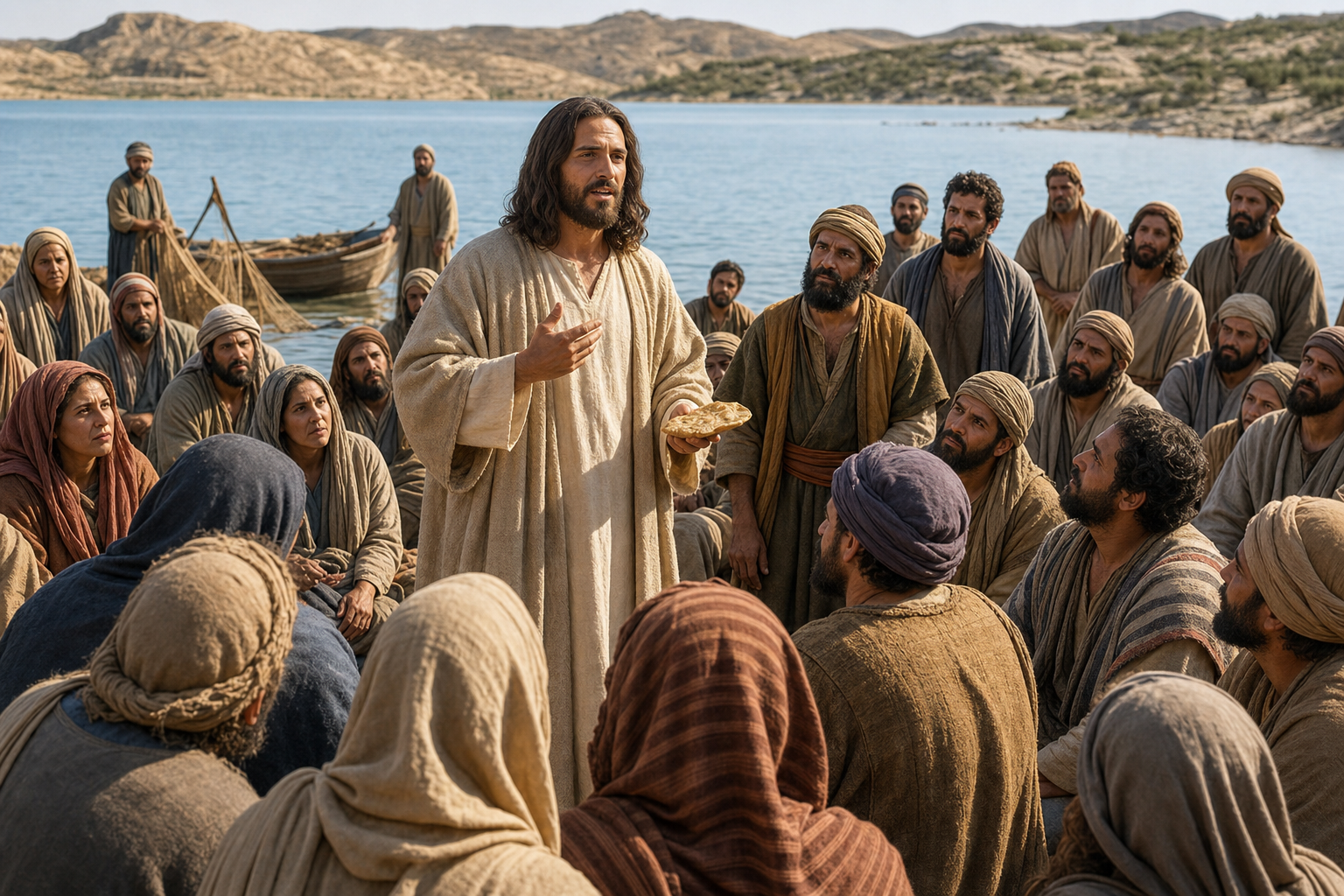
First, the feeding. The disciples see a crowd and want to send them away. It's practical. It's also detached. Jesus makes it their concern: "You give them something to eat." They have five loaves and two fish. Not enough. Jesus takes it, blesses it, breaks it, and feeds everyone with leftovers. He isn't stretching a supply chain. He's acting with the kind of power that belongs to the Creator. Abundance shows up where there wasn't any.

Then the storm. Jesus sends the disciples out, the wind hits, and they're stuck fighting water and fear. Jesus walks to them on the sea and says, "Take heart; it is I. Do not be afraid." That isn't bravado. It's authority over what humans can't control. The chaos that owns everyone else is under His feet.

These are signs. They show who He is, and they show what His kingdom brings. In Jesus' presence, hunger is met and fear is confronted. The world we live in is bent - scarcity, anxiety, sickness, death. Jesus treats those as enemies, not as normal.

So you're meant to leave this passage asking two questions: who is this man, and what does it mean to follow Him? We don't manufacture miracles. We do carry His compassion into hungry, stressed, storm-tossed places, and we do point people to the King whose authority is real.

Day 41

OFFERING

July 11

Luke 21:1-4 - The Purpose of Parables

Jesus sits near the offering box and watches people give. That scene should make you a little uncomfortable, because it means He pays attention to what we do with money.

The rich give large amounts. It's visible. It sounds impressive. Then a poor widow drops in two small coins - "all she had to live on." Jesus says she gave more than all the rest. Not because the amount was larger, but because the sacrifice was. Her gift came out of need. It carried risk. It meant trust.

And Jesus doesn't tell this story to create guilt. He tells it to show what grace produces. The gospel says God did not hold back from us. He gave His Son. Jesus didn't contribute out of surplus; He gave Himself when we had nothing to offer Him. That's the center. Before generosity is a command, it's a response.

So the widow isn't a fundraising illustration. She's a picture of dependence. Her two coins say, in effect, "God is my security." And that is exactly what Jesus deserves, because He has already become our security - by going to the cross.

So the question isn't "Did I give something?" The question is "What does my giving say about what I trust?" Christian generosity is not tipping God or paying dues. It's joining the pattern of the crucified King - open-handed, sincere, and willing to lay down comfort so others can live.

Day 42

PERSISTENCE

July 12

Luke 18:1-8 - A persistent widow

Another widow story, and this one is basically a masterclass in holy stubbornness.

Jesus tells a parable about a widow who keeps coming to an unjust judge: "Give me justice." He doesn't fear God, doesn't respect people, and he ignores her until she wears him down. He finally responds, not because he's become righteous, but because persistence wins.

Jesus praises her - not because noise is virtue, but because she understands reality. She knows who has authority to act, and she refuses to stop asking until help comes. She brings her need to the one place it can actually be addressed.

Then Jesus makes the comparison: if an unjust judge can be moved, how much more will a just Father hear His children? That's gospel logic. God is not distant. God is not reluctant. In Christ, you've already been welcomed. The cross settled the question of whether God cares; you don't have to earn access with perfect prayers. You come as a child, because you are one.

So prayer isn't an occasional religious gesture. It's steady dependence. Keep coming. Keep asking. Keep trusting, especially when the answer is slow. Delay doesn't mean abandonment. It often means God is doing more than you can see - forming patience, purifying desires, keeping you close.

And this isn't only for your personal sanity. Persistent prayer is mission fuel. We ask for justice, for mercy, for change, for salvation, because the world needs more than our exhausted effort - and because the Father hears, the Son intercedes, and the Spirit keeps us moving.

Day 43

REBORN

July 13

John 3:1-21 - Born Again

Nicodemus has the résumé: educated, respected, serious about God. He comes to Jesus at night, careful and controlled. Jesus goes straight to the point: "Unless one is born again he cannot see the kingdom of God" (John 3:3). Nicodemus came for a conversation. Jesus gives him a verdict.

Because the problem isn't that you need more information or a cleaner track record. The problem is life itself. "That which is born of the flesh is flesh, and that which is born of the Spirit is spirit" (3:6). New birth is not self-generated. It's not willpower. It's not getting your act together. It's the Spirit doing what only God can do: making a person new from the inside.

Then Jesus tells you what that new life costs and where it comes from: "God so loved the world, that he gave his only Son" (3:16). The new birth isn't a reward for progress. It's a gift purchased by Jesus. God's love is not sentimental tolerance. It's action. He gives His Son so sinners can be forgiven, cleansed, and brought into life with Him.

So "born again" is not a religious upgrade. It's a new beginning new desires, a new center, a new direction. And it produces witnesses. People who have been made alive start living openly, telling the truth, and pointing others to the same mercy that found them.

Day 44

AUTHORITY

July 14

John 5:19-29 - The Authority of Jesus

The question underneath most resistance to Jesus is simple: who gave Him the right? Jesus answers without softening it. His authority comes from the Father, and He acts in full unity with the Father: "The Son can do nothing of his own accord, but only what he sees the Father doing" (John 5:19). He is not offering a private opinion. He is exercising divine authority.

He spells out what that includes. He gives life: "the Son gives life to whom he will" (5:21). He will judge the world: "the Father... has given all judgment to the Son" (5:22). He receives the honor due to God: "whoever does not honor the Son does not honor the Father" (5:23). And He claims authority over the grave itself: a day is coming when those in the tombs will hear His voice and rise (5:28-29).

Those claims force clarity. Jesus does not present Himself as one wise teacher among many. He claims the power to raise the dead and the authority to render the final verdict on every life.

That means discipleship is not a decorative add-on. If Jesus is telling the truth, then listening and responding is the only rational move. And His authority is not only something to admire; it sends people. Those who receive His life become witnesses - speaking, serving, and living with the settled conviction that death is not ultimate and that the risen Christ reigns now.

Day 45

am

July 15

John 6:22-59 - I am the Bread of Life

The crowd follows Jesus after the feeding because need is persuasive. They want more bread, more certainty, more control over tomorrow. Jesus refuses to play that role. He forces the question beneath the appetite: what are you actually living on?

Then He says, "I am the bread of life" (John 6:35). Bread is daily and necessary. It keeps you alive. Jesus uses that ordinary reality to make a claim about Himself. He brings up the manna in the wilderness: Israel ate miraculous food and still died. God's gifts are real, but they cannot carry the weight of being ultimate. They weren't designed to.

Jesus tightens the point: the true bread is not a thing from heaven; it is the One who comes down from heaven and "gives life to the world" (6:33). He is claiming divine origin and the authority to give life.

That's why His words about eating His flesh and drinking His blood are so direct: "Whoever feeds on my flesh and drinks my blood has eternal life" (6:54). He is describing dependence and union. Not admiration from a distance. Not religious agreement. Receiving Him as your life.

This is also why the "I am" statements matter. They are not slogans. They define identity. Jesus is presenting Himself as the only source that holds when everything else runs out.

And He is not bread for private comfort only. He gives life "to the world." People who feed on Him learn where to point other hungry people, and they become part of how God feeds them.

Day 46

washed

July 16

John 13:1-20 - Washes disciple's feet

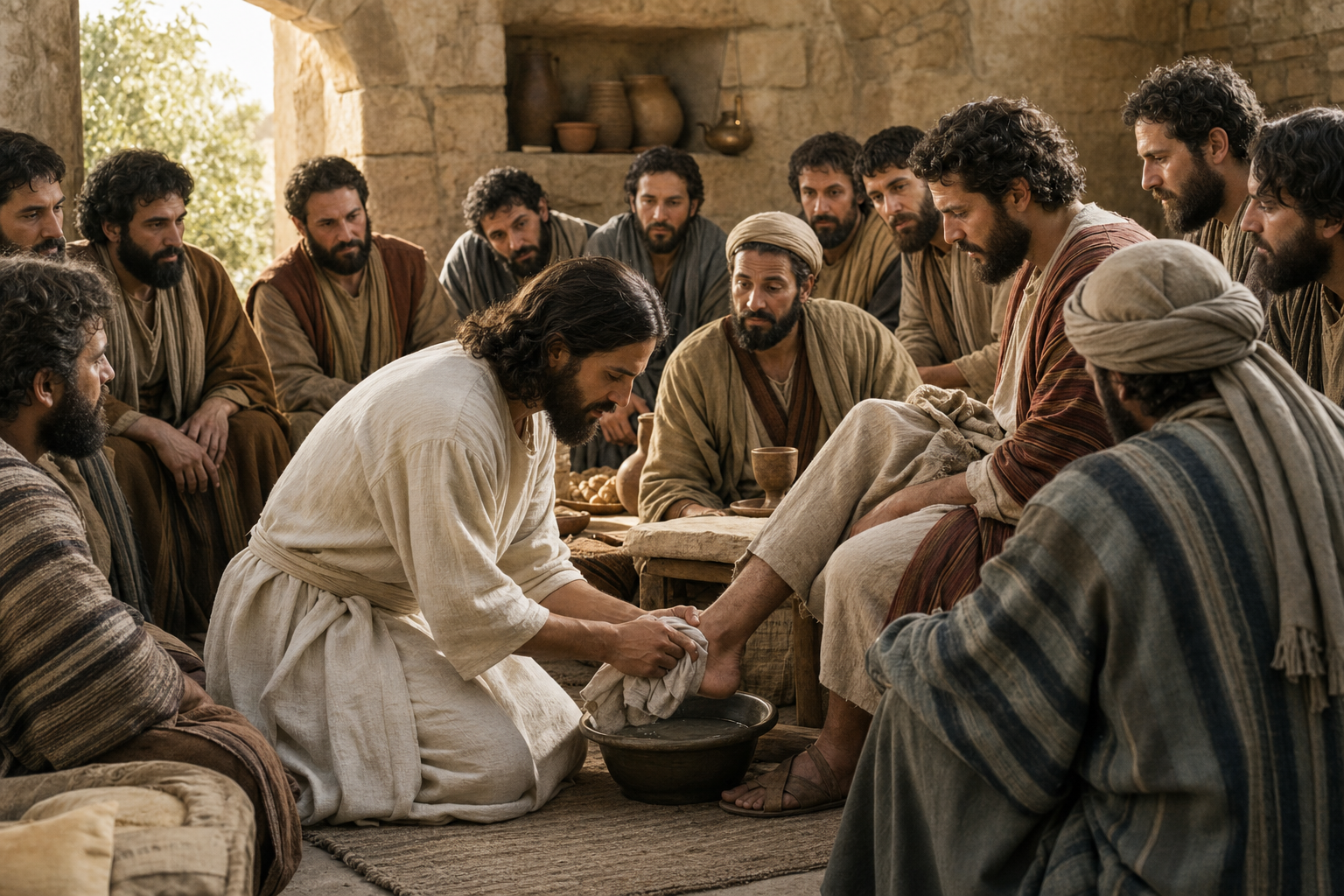
On the night Jesus is about to be betrayed, He takes a towel and washes His disciples' feet (John 13:1-20). In that world, feet were dirty, and this was the lowest kind of work. Jesus chooses it anyway.

He does it with full awareness of who He is: "the Father had given all things into his hands" (13:3). The point is not that Jesus lacks authority. The point is what He does with it. He uses power to serve.

Peter resists because it feels wrong. Jesus insists: if Peter will not receive His cleansing, he has no share with Him (13:8). The order matters. The gospel begins with receiving. Jesus serves first. Jesus cleanses first. Only then do His people learn how to serve in His name.

Afterward, Jesus makes the implication explicit: "If I then, your Lord and Teacher, have washed your feet, you also ought to wash one another's feet" (13:14). He is not giving a sentimental lesson about humility. He is setting a pattern for life in His kingdom. Love takes the lower place. Love assumes responsibility. Love absorbs cost for the good of another.

This act also points forward. The towel anticipates the cross. The same Christ who washes feet will give His life. Service is not an optional virtue for Christians; it is the shape of discipleship under a crucified Lord.

People who have been cleansed by Jesus become people who serve like Jesus.

Day 47

TRADITION

July 17

Matthew 15:1-20 - What defiles a person?

Religious leaders confront Jesus over hand-washing traditions. The issue is not cleanliness. It's purity - who counts as clean, who counts as dirty, and how you manage your standing with God. Their system is external and controllable: the right foods, the right contacts, the right habits. It creates the feeling of righteousness without requiring a changed heart.

Jesus moves the whole conversation to the center. Defilement is not mainly about what goes into a person; it's about what comes out. "Out of the heart come evil thoughts... murder, adultery, sexual immorality, theft, false witness, slander" (Matt. 15:19). The heart is the source. Behavior is downstream.

That diagnosis matters because it changes what you need. External management can produce external compliance. It cannot produce love for God, love for neighbor, or lasting freedom from sin. The core problem is internal, and the solution has to be internal.

This is where the gospel comes in. Jesus doesn't merely demand a cleaner life. He comes to deal with the heart. He exposes sin honestly and then provides cleansing through His own work - what the prophets promised and what His death and resurrection secure. Forgiveness is real, and new life is real.

When the heart is cleansed, the rest follows: truth replaces pretense, love replaces comparison, and obedience becomes something more than image management. That kind of person becomes safe for others and useful in mission, because they are no longer trying to prove themselves clean; they are living from the mercy they have received.

Day 48

CONFESSION

July 18

Matthew 16:13-20 - Peter confesses that Jesus is the Christ

Jesus asks His disciples what people are saying about Him. They offer serious answers: a prophet, a reformer, a holy man. Then He presses the question that matters: "But who do you say that I am?" (Matt. 16:15). It's personal because it can't stay theoretical. You can admire Jesus and still miss Him.

Peter answers: "You are the Christ, the Son of the living God" (16:16). He identifies Jesus as the Messiah - God's promised King and as God's Son. Jesus responds that this confession did not come from human insight but from the Father's revelation (16:17). The point is not that Peter is unusually perceptive. The point is that God is making Jesus known.

This is where the gospel becomes unavoidable. Many people prefer a manageable Jesus: inspiring, moral, supportive, and silent about authority. Jesus refuses that category. He requires a decision about His identity, because His identity determines everything that follows how you understand God, what you trust, what you obey, and what you build your life on.

Jesus then ties that confession to the church and its future. This truth is foundational: the church exists because Jesus is the Christ and the Son of the living God, and it advances because that reality is announced and believed. Christian mission is not inviting people into vague improvement. It is calling people to see and confess who Jesus is, and then to follow Him as King.

Day 49

FORESHADOWING

July 19

Matthew 16:21 - Jesus foretells his death and resurrection

In Matthew 16:21 Jesus tells His disciples where this is going. He is going to Jerusalem. He will suffer. He will be killed. He will rise on the third day. He is not speaking in riddles. He is setting the terms of His mission.

The disciples struggle to receive it because they expect the Messiah to win through visible power. They can imagine triumph. They cannot imagine a cross. A suffering Savior does not fit their framework, and it confronts ours as well. Most people want a God who supports their plan and removes obstacles. Jesus announces that He will accomplish salvation by walking straight into suffering.

This is not fatalism. It is deliberate. Jesus is not being swept along by events. He is moving toward the cross with intention. The suffering is necessary because it is the way sin is dealt with and reconciliation is secured. Resurrection is not an afterthought; it is the promised outcome.

This is the center of the gospel: the King saves by giving His life. The cross is not a regrettable detour. It is the means by which God loves and rescues the world.

And it reshapes discipleship. If Jesus saves through self-giving, His followers cannot treat faith as comfort and self-protection. Cross-shaped people learn to spend their lives for others because they have been loved and saved by a crucified and risen Lord.

Day 50

GREATEST

July 20

Matthew 18:1-6 - The Greatest in the Kingdom

The disciples ask Jesus who is greatest in the kingdom. It's the question behind most ambition: who matters, who is ahead, who gets noticed. Jesus answers by redefining greatness rather than mocking the desire.

He places a child in front of them and says that entrance into the kingdom requires turning and becoming like children, and that the greatest is the one who humbles himself like a child (Matt. 18:3-4). In that culture, children had no status, no leverage, no social weight. Jesus points to someone unimpressive by the world's standards and makes that posture central.

The point is not childishness. It is dependence and humility. The kingdom is received, not seized. Greatness is not dominance; it is a willingness to take the lower place and to trust God for status and security.

That has practical force. At home, greatness looks like steady presence, patience, and the strength to repent quickly. In spiritual life, it looks like obedience that doesn't need an audience and honesty that doesn't wait until you are forced. In work, it looks like excellence without using people, truth without spin, and responsibility without ego.

Jesus is not shutting down ambition. He is redirecting it. He is building a community where strong people use their strength to protect and lift up the small. That is what His kingdom looks like, and it is how His mission moves forward.

Day 51

cut

July 21

Matthew 18:7-9 - The seriousness of sin

Jesus speaks about sin with urgency because He takes people seriously. He knows what sin does to a life and to a community.

He says temptations will come, but He warns against causing others to stumble. Then He uses extreme language: if your hand or foot causes you to sin, cut it off; if your eye causes you to sin, tear it out. He is not promoting self-harm. He is insisting on moral seriousness. Sin is not something to tolerate and manage. It must be confronted and put to death.

The reason is simple: sin destroys. It corrodes integrity. It reshapes desire. It damages relationships. It trains you to hide, to excuse, to rationalize, and then to repeat. It rarely stays private, and it rarely stays small. What you feed grows.

Jesus' point is that decisive action now is better than slow ruin later. If there is a pattern that is pulling you toward destruction, treat it as an emergency. Remove access. Change your habits. Tell the truth. Seek help. Stop pretending you can keep it under control while keeping it close.

The gospel matters here. Jesus does not only forgive. He also changes people. He gives pardon and power - real mercy for failure and real strength for obedience. That matters for mission as well. Holiness is not retreat from the world; it is credibility and clarity in the world. People need to see that Jesus frees people, not just that Jesus is talked about.

Day 52

RECONCILIATION

July 22

Matthew 18:15-35 - Reconciling with others

Matthew 18:15-35 gives a clear path for dealing with sin and conflict, and it aims at reconciliation.

Jesus begins with a private conversation: go to the person directly (18:15). Not public pressure. Not indirect comments. Not recruiting support to strengthen your position. Speak plainly, with the goal of restoring the relationship. If the person listens, that is the outcome Jesus wants: you have gained your brother or sister.

If the person refuses to listen, Jesus widens the circle in a controlled way. Bring one or two others (18:16). The purpose is fairness and clarity, not escalation. If there is still refusal, the church becomes involved (18:17). Jesus is serious because unchecked sin harms people and damages community.

Then Jesus addresses the other half of reconciliation: forgiveness. Peter asks how far forgiveness should go, and Jesus answers with a story. A servant is forgiven an unpayable debt and then refuses to forgive a small debt owed to him (18:21-35). The contrast is meant to land hard. People who receive God's mercy cannot live as if they are entitled to withhold mercy from others.

The gospel holds these two together: truth and mercy. Jesus does not reconcile by ignoring sin. He confronts it, bears its cost, and brings people back to God. That becomes the pattern for His people. Reconciled people pursue reconciliation, and a church that practices both confrontation and forgiveness makes the gospel visible.

Day 53

RICH

July 23

Matthew 19:16-30 - The Rich Young Man

A rich young man comes to Jesus with a question that reveals his framework: "What good deed must I do to have eternal life?" He wants a clear task and a clear result. Jesus engages the commandments, and the man insists he has kept them.

Jesus then presses to the center: "Sell what you possess... give to the poor... and come, follow me" (Matt. 19:21). The man goes away sad. The issue is not that generosity is a special entrance fee. The issue is what owns him. His wealth is not only money; it is security and control. Jesus puts His finger on the rival allegiance.

This is how idolatry works. A good thing becomes ultimate. It becomes the place you look for meaning, safety, and identity. For this man it is wealth. For others it can be career, comfort, reputation, pleasure, control, or even family. Jesus exposes it because following Him requires a whole heart. You cannot cling to a competing god and follow Christ at the same time.

The gospel is central here. Jesus is not offering moral improvement through stronger effort. He is calling for trust and allegiance, and He will later give Himself for sinners who cannot free themselves. His demand is serious because His gift is serious.

This also shapes mission. People who follow Jesus are freed from chasing lesser kingdoms. They become a visible witness that there is treasure worth more than what the world protects at all costs, and that life is found by following the King.

Day 54

TRIUMPH

July 24

Matthew 21:1-11 - Jesus' triumphal entry

Jesus enters Jerusalem publicly and deliberately. He rides a donkey, fulfilling the pattern of a humble king, and the crowds shout "Hosanna" as the city takes notice (Matt. 21:1-11). This is not accidental. Jesus is presenting Himself as the promised King.

But He refuses to use that moment the way people expect. The crowd wants a leader who will seize power, punish enemies, and deliver immediate relief. Jesus keeps moving toward suffering. He speaks and acts as someone committed to a mission that will cost Him His life.

That is the tension of this passage. Jesus is a King, and His kingship is real, but His victory will not come through domination. He will not establish His kingdom by taking lives. He will establish it by giving His own. His entry into Jerusalem is the beginning of a path that leads to the cross.

This is gospel-centered kingship. The problem Jesus comes to address is deeper than Rome. The real enemy is sin and death. Jesus confronts it by substitution and sacrifice. He chooses the cross as the means of rescue.

This also defines discipleship and mission. Followers of Jesus do not spread His kingdom through coercion or self-promotion. They bear witness to a King who served and suffered, and they learn to live with the same pattern: public allegiance, humility, truthfulness, and costly love. The church's witness is meant to reflect the character of its King.

Day 55

SUPPER

July 25

Matthew 26:17-46 - Jesus's last night

Matthew 26 is the night the story becomes heavy. The public momentum fades and the cross comes into view.

At the meal, Jesus takes bread and wine and ties them to Himself: His body given, His blood poured out "for many" for the forgiveness of sins. He names betrayal at the table and denial among His closest friends. The disciples insist they will remain loyal. Jesus doesn't argue with their intentions. He tells them what will happen, because truth matters more than confidence.

Then comes Gethsemane. Jesus is clear about His sorrow: "My soul is very sorrowful, even to death" (26:38). He prays with honesty: "My Father, if it be possible, let this cup pass from me" (26:39). He is not detached. He feels the weight of what is coming.

And then He submits: "Nevertheless, not as I will, but as you will." His friends cannot stay awake. Jesus does. He chooses obedience with full awareness of the cost. He is not cornered by events; He is resolved to rescue.

This is gospel-centered mission. The cross is not a tragic accident. It is the means by which sin is forgiven and sinners are welcomed. The Lord's Supper places that reality into the life of the church: Christ given for us, Christ poured out for us. Every table shaped by Jesus becomes a place where His people remember what saved them and learn how to live as witnesses to His sacrificial love.

Day 56

CRUCIFIED

July 26

Matthew 26-27 - The death narrative

If you want to know what God thinks about sin and what God is willing to do about it, don't start with theories. Start with the cross.

Matthew 26-27 shows the crucifixion without cleaning it up: betrayal, false accusations, mockery, fists, spit, thorns, nails, and death. Jesus does not bypass the human cruelty or the bodily pain. He also bears a deeper weight. Darkness falls, and He cries, "My God, my God, why have you forsaken me?" (27:46). That is the language of judgment and abandonment.

The big idea is substitution. Jesus is not mainly showing us how to suffer bravely. He is carrying what we cannot carry. Our sin is not minimized or ignored. It is placed on Him and judged in Him. The sentence falls on the substitute so the guilty can go free.

That is why the cross sits at the center of the gospel. It is where God's justice and God's mercy meet. It is where love takes action instead of offering advice. Jesus absorbs the curse so reconciliation becomes possible.

And it changes what can be true about your life. If Christ has borne sin in full, guilt does not have the final word. Shame does not have the final word. Your past does not have the final word. Jesus does.

And that is why this cannot remain private. A crucified substitute is not a personal coping strategy. It is news - good news - for sinners who need forgiveness and for a world that needs a Savior.

Day 57

DENIAL

July 27

Matthew 26-27 - Peter's Denials

Confidence is easy when the cost is theoretical. Peter learns that in one night.

He tells Jesus he will stay loyal no matter what. Jesus says Peter will deny Him three times. Then the arrest happens. Things get dangerous. Peter keeps close enough to see what's happening and far enough to stay out of trouble. When people press him - "Do you know him?" - he chooses self-preservation. Three times.

That failure lands because it's familiar. When pressure spikes, most people reach for safety: protect the job, protect the reputation, protect the life they've built. Peter does what many of us do - he edits his story to survive the moment. Then the rooster crows and it hits him all at once. He breaks.

Peter's collapse doesn't derail Jesus. It shows why Jesus has to go to the cross. The gospel isn't built for the steady and impressive. It's built for people who mean well and still fold when the stakes get real. Peter will be restored, not by ignoring what happened, but by being met inside it. Jesus doesn't keep him at arm's length. He brings him back and gives him work to do.

That's the point for anyone carrying shame. Failure is not the end of your story. Grace is stronger than your worst night. And people who have been forgiven without pretending become useful - because they stop performing and start telling the truth.

Day 58

RESURRECTION

July 28

Matthew 28:1-15 - The Resurrection

The women go to the tomb early with spices because they expect a body. They are not looking for a miracle. They are handling grief and doing what you do when someone is gone.

Then the ground shakes, the stone is moved, the guards collapse, and the tomb is empty. Jesus is alive.

Christianity stands or falls on that. If Jesus stayed dead, then the message reduces to ideas and example. If He rose, then reality has shifted. A dead man does not walk out of his grave unless God acts.

The resurrection means death has lost its final authority. It still hurts and it still takes people, but it no longer owns the outcome. Jesus has gone through it and come out the other side.

It also means sin has been dealt with. The cross is not only a display of love. It is payment. Jesus carries guilt into death, and the empty tomb is God's public declaration that the payment is accepted and forgiveness is real. New life is not a motivational concept; it is a possibility grounded in an event.

Matthew includes the cover story and the bribes because the resurrection threatened existing power. People tried to control the narrative. They failed.

The risen Jesus is not a memory to respect. He is a living King. That is why mission exists: the news is true, and the world needs more than advice. It needs a Savior who has defeated death.

Day 59

ASCEND

July 29

Luke 24:13-53 - Appearances and Ascension

The resurrection accounts are grounded in ordinary settings and multiple witnesses. Luke presents people who are not expecting a comeback. They are grieving and confused.

On the road to Emmaus, Jesus walks with two disciples who are processing loss. He explains the Scriptures and shows how the story points to Him (Luke 24:27). Then He eats with them, and they recognize Him (24:30-31). The scene is physical and concrete.

Jesus then appears to the larger group. They assume they are seeing a spirit. Jesus shows them His hands and feet, invites them to touch Him, and eats in front of them (24:39-43). Luke emphasizes that this is bodily resurrection, not a private experience or a symbolic idea. These same disciples had been fearful and scattered. After seeing the risen Christ, they become witnesses who speak publicly and accept real cost. The change in them is part of Luke's argument: they did not invent this story to gain comfort or status.

Luke ends with the ascension. Jesus blesses them and is taken up (24:50-53). The point is not only that He rose, but that He reigns. The risen Jesus is not a memory and not absent. He is the enthroned Lord.

That shapes mission. The church does not work from panic or self-protection. It bears witness from settled confidence that Jesus is alive, His promises are reliable, and His authority is already established.

Day 60

COMMISSION

July 30

Matthew 28:16-20 - The Great Commission

Jesus meets His disciples after the resurrection and gives them their assignment. Matthew notes that some worship and some doubt. Jesus does not wait for perfect confidence. He speaks to real people and gives them clarity.

He begins with the foundation: "All authority in heaven and on earth has been given to me" (Matt. 28:18). The mission rests on who He is and what He has done. If Jesus has conquered sin and death, then His authority is not theoretical. It is present and total.

Then He gives the command: "Go therefore and make disciples of all nations" (28:19). The goal is not vague spirituality or moral improvement. It is to bring people to Jesus, baptize them into a new identity, and teach them to obey Him in all of life (28:19-20). That work is relational and steady. It happens through conversation, hospitality, instruction, and faithful example over time.

Jesus ends with the promise that makes the mission possible: "I am with you always" (28:20). He does not send His people out alone. He is present with them as Lord.

This passage is the transition from Jesus' ministry to the church's mission. Those who have received mercy are sent to extend it. The Great Commission is not optional. It is the risen King's directive for His people, carried out in reliance on His authority and His presence.

Day 61

TRANSITION

July 31

John 15:26-16:15 - The Work of the Holy Spirit

Jesus prepares His disciples for what comes after His departure. He tells them opposition will increase and that they will be tempted to fear and retreat. He does not leave them with vague reassurance. He promises the Helper, the Holy Spirit (John 15:26).

The Spirit's work is tied to Jesus and to mission. He will bear witness about Christ, and He will enable Christ's people to bear witness as well (15:26-27). The church's witness is not powered by human confidence or skill. It is sustained by God's presence and power.

Jesus also says the Spirit will convict the world concerning sin, righteousness, and judgment (16:8). That means conversion is not something disciples can produce through pressure or cleverness. Their responsibility is to speak and live faithfully. The Spirit's responsibility is to open eyes and bring conviction where it is needed.

For the disciples themselves, the Spirit will guide them into truth (16:13). He will not draw attention to Himself; He will glorify Jesus (16:14). The Spirit's ministry is to make Christ known, trusted, and obeyed.

This passage functions as a bridge into the rest of the New Testament. Jesus ascends, the Spirit comes, and the mission advances. Jesus does not send His people with a message alone. He gives them His own presence through the Spirit, along with courage, clarity, and endurance to witness in a resistant world.

Day 62

PENTECOST

August 01

Acts 2 - Pentecost and the Early Church

Acts 2 is the church's public beginning, and the driving force is the Holy Spirit.

Pentecost brings a crowded city. The Spirit comes with wind and fire, and the disciples speak in other languages. The sign matters because it announces something new: Jesus has ascended, and His people have not been left on their own. God is present with them in power.

Peter then preaches Jesus - crucified, risen, and exalted. The result is conviction, repentance, and baptism. The message is centered on Christ and His work, and the response is a visible turning to Him. The church begins with gospel proclamation and Spirit-enabled conversion.

Luke then describes the shared life that forms (2:42-46). They devote themselves to the apostles' teaching, fellowship, breaking bread, and prayer. Their community is marked by generosity and practical care. They share resources, eat together, worship together, and carry a sense of awe. This is not idealized perfection. It is a new kind of people being formed around Jesus.

The main point is that the church does not start as a human project. The Spirit creates a witnessing community. He gives courage, unites people who would not naturally unite, and produces a life that matches the message.

Pentecost also signals a reversal of Babel. Where language once divided, the Spirit enables understanding and gathers people across nations around the risen Christ.

Day 63

STONED

August 02

Acts 7 & 9 - Stephen's speech and Saul's Conversion

Acts 7 and 9 place Stephen and Saul side by side to show both the cost of witness and the reach of grace.

Stephen speaks to Israel's leaders and traces their history of resisting God's messengers. He concludes that they have rejected the Righteous One. The response is violent. Stephen is killed, and Saul is present, approving and participating (Acts 7:58-8:1). Saul's posture is not uncertainty. He is convinced he is defending God.

That is Saul's background: zeal, education, authority, and a strong sense of moral purpose. He uses power to silence the church because he believes the church is a threat.

In Acts 9, Saul is on the road to Damascus with orders to arrest Christians. Jesus intervenes. Saul hears the voice: "Why are you persecuting me?" (9:4). When Saul asks who is speaking, the answer is direct: "I am Jesus" (9:5). Saul is blinded and led into the city. Then God sends Ananias to restore his sight, call him "brother," and bring him into the community he intended to destroy.

The main idea is the radical grace of God. God does not wait for Saul to soften. He confronts him, forgives him, and commissions him. A persecutor becomes a witness.

Stephen's death is not wasted. It shows that gospel witness can cost a life, and still serve God's purposes. Saul's conversion shows that no sinner is beyond the reach of Christ.

Day 64

VISION

August 03

Acts 10 - Peter's vision, Acts 15 - Jerusalem Council

Acts 10 and Acts 15 mark a decisive shift in the church's life together. The question is whether Gentiles belong fully in God's people, and on what basis.

In Acts 10, Peter receives a vision of animals he has been trained to call unclean. God tells him to eat. Peter resists, and God answers, "What God has made clean, do not call common" (10:15). The point becomes clear when Peter is sent to Cornelius, a Gentile. Peter enters his home, hears his story, and preaches Jesus. The Holy Spirit is poured out on Gentiles in the same way He was poured out on Jewish believers. God gives them the same gift without delay or second status.

Acts 15 addresses the resulting conflict. Some argue that Gentile believers must be circumcised and required to keep the law of Moses. The Jerusalem Council rejects that demand. Salvation is by grace through faith in Jesus, not by adopting Jewish cultural markers. They give guidance for unity and fellowship, but they refuse to rebuild a barrier that Christ has removed.

The theological point is central: in Christ, God is forming one people. The church is not an ethnic tribe expanded by conversion into a culture. It is a new community created by the Spirit, centered on Jesus, and defined by grace.

This also shapes mission. The gospel crosses boundaries, and the church must follow. The Spirit enlarges the family and teaches God's people to treat grace as the basis of belonging.

Day 65

athens

August 04

Acts 17 - Paul preaching on Mars Hill

Even the people who claim they "don't do religion" still organize their lives around something they treat as ultimate.

Paul walks into Athens, a city full of temples and ideas, and he names what he sees: "I perceive that in every way you are very religious" (Acts 17:22). He isn't mocking them. He's diagnosing them. They are worshipers. Their worship is just misdirected.

He points to an altar labeled "To the unknown god" and says he will make known the God they do not truly know. He begins with creation and dependence: God made the world, gives life and breath, and is not contained by human buildings or sustained by human offerings (17:24-25). That confronts the assumption that spirituality is something we manage.

Paul then presses the implication: if we are God's offspring, God cannot be reduced to an object we shape and control (17:28-29). And because God is personal and moral, He "commands all people everywhere to repent" (17:30). Repentance is required because judgment is real. Paul stakes the claim on one public event: God has appointed a judge and has given proof by raising Jesus from the dead (17:31).

Mars Hill exposes a basic truth: the issue is not whether someone worships, but what they worship, and whether that object can carry a human life.

This is also a model for mission: understand the culture, speak clearly, and center everything on the risen Christ.

Day 66

WRATH

August 05

Romans 1:16-32 - The reality of sin and wrath

Sin is not a minor defect in otherwise healthy people. Paul describes it as a refusal of reality.

He says humans "suppress the truth" (Rom. 1:18). God is not hidden in principle. Creation itself points to Him, but people resist that knowledge because it threatens autonomy. The result is what Paul calls an exchange: worship shifts from the Creator to created things (1:23, 25). People give ultimate weight to what they can measure and control - sex, money, success, comfort, approval. Those gods demand more and give less. They cannot forgive, cannot secure, and cannot satisfy.

Paul then describes God's wrath in a way that should sober anyone who assumes judgment means random anger. Three times he says, "God gave them up" (1:24, 26, 28). Wrath includes God handing people over to the path they insist on and allowing the consequences to unfold. Sin carries its own destruction. It distorts desire, damages relationships, and erodes a person from the inside while they keep calling it freedom.

This is not written to produce despair. It is written to clarify what needs saving. If the problem is worship turned inward and downward, the solution is not external adjustment. The solution is rescue - new worship, new heart, new life in Christ.

Romans tells the bad news with precision so the gospel can land with force. The mission is not polishing decent people. It is announcing mercy to rebels and inviting them to return to the God they were made for.

Day 67

ROAD

August 06

Romans 2-6 - The Gospel Road

Most people carry a working assumption: as long as you're not the worst person you know, you're fine. Paul dismantles that in Romans 2. Moral comparison doesn't solve guilt. It often hides it. Everyone is accountable to God, and everyone avoids truth when it threatens comfort.

Romans 3 states the verdict: "All have sinned and fall short of the glory of God" (3:23). That's not a comment about a few bad choices. It's a statement about falling short of what humans were made for - life centered on God.

Then the gospel enters at the point of failure. God justifies sinners by grace through the redemption that is in Christ Jesus (3:24-26). Justification means the verdict changes because of Jesus, not because of your record. Romans 5 makes the timing clear: "While we were still sinners, Christ died for us" (5:8). God acts first.

Romans 6 adds the promise of freedom: "The wages of sin is death, but the free gift of God is eternal life in Christ Jesus our Lord" (6:23). Sin pays out death. God gives life. The gospel does not only forgive; it breaks sin's claim and gives a new identity.

Union with Christ means His death counts as yours and His life becomes yours. That is how the Christian life begins and continues: received righteousness, real change, and a new direction. Freed from the need to justify yourself, you can begin to love and serve without performing for approval.

Day 68

Choice

August 07

Romans 8:28-30, ch. 9, 10 - God's sovereign choice

Control is the modern drug of choice, and nothing threatens it like the idea that salvation belongs to God.

Paul's argument forces a basic question: who is doing the saving? Romans 8 says God's purpose is not comfort but conformity to Christ - being shaped into the image of His Son (8:29). The famous promise that "all things work together for good" is tied to that purpose (8:28). Paul then stacks God's actions - foreknew, predestined, called, justified, glorified - so you feel the point: God begins it, God carries it, God finishes it.

Romans 9 presses the implication. Mercy is mercy. It isn't owed. Salvation does not rest on human effort or human deserving. That removes boasting and dismantles the fantasy that the decisive factor is your moral potential.

Romans 10 keeps the invitation fully open: "Everyone who calls on the name of the Lord will be saved" (10:13). The call is real. The responsibility is real. People come in by faith, not by pride.

This is hard only if you need to be the hero of your own rescue. It is also solid ground. If salvation depends on God's mercy, then hope does not swing with your performance.

And it fuels obedience and mission. Romans 8 begins with no condemnation, gives the Spirit's power, and ends with secure adoption. People who know they are received stop trying to earn a place and start living and speaking as witnesses to the mercy that saved them.

Day 69

conform

August 08

Romans 12:1-2 - Do not be conformed to this world

The world doesn't need to kick your door down to shape you. It just stays in your ear long enough, and eventually you start calling its priorities "normal."

Paul calls that conformity. It isn't only about behavior; it's about formation. What you celebrate, what you fear, what you pursue, what you excuse - those choices add up, and they shape a person.

So he calls for a decisive response: "present your bodies as a living sacrifice" (Rom. 12:1). That is concrete. Your time, money, attention, work, sexuality, speech, and ambition belong to God. Worship is not limited to a service; it's the offering of your life.

Then comes the core command: "Do not be conformed to this world, but be transformed by the renewal of your mind" (12:2). The mind matters because what you believe determines what you tolerate and what you chase. Renewal means God's truth reshapes your instincts, not just your opinions. Over time you become able to "discern... the will of God," what is truly good and worth pursuing (12:2).

This is not about being different for the sake of being different. It is about alignment with reality. The gospel doesn't only forgive; it re-forms. A renewed mind produces a recognizable life - one that resists the pressure to perform, consume, and compare, and instead reflects what it means to belong to Christ. That kind of life becomes its own witness.

Day 70

stumble

August 09

Romans 14 - Don't cause another to stumble

Freedom feels great until it costs someone else.

In the early church, many believers came out of strict purity laws and suddenly had real liberty around food, days, and practices. Others had tender consciences shaped by their past, and certain actions still pulled them toward fear, shame, or old patterns. That mix created friction. Some felt superior because they were "free." Others felt superior because they were "careful." Paul refuses both.

He grounds the whole issue in Lordship. You don't answer to each other; you answer to the Lord (Rom. 14:4, 12). Then he gives a hard command: decide never to put a stumbling block in the way of a brother or sister (14:13). Your choices are not private if they weaken someone else's faith. "I can handle it" is not a sufficient reason if it harms another person.

Paul's standard is love. If your practice grieves another believer or pulls them toward sin, you are no longer walking in love (14:15). That requires maturity: the ability to limit your own freedom for the good of someone else.

He also resets the priorities. The kingdom of God is not built on these secondary issues. It is "righteousness and peace and joy in the Holy Spirit" (14:17). That is what matters.

This is gospel logic applied. Jesus laid down His rights for the sake of others. People who have received that mercy learn to use their freedom the same way - serving, protecting, and building up.

Day 71

folly

August 10

1 Corinthians 1:18-2:5 - Wisdom of World and the Wisdom of Christ

The kind of "wisdom" our world rewards is built for applause: status, polish, confidence, control. It teaches you that if you get smart enough and strategic enough, you can protect yourself from pain and secure a life that holds. Most people find out the limits of that approach the hard way.

Paul puts the cross at the center and calls it God's wisdom and power (1 Cor. 1:18). That is offensive to pride because it says the deepest problem is sin and the solution is not self-improvement. It is rescue. A crucified Messiah looks weak to anyone trained to respect dominance. Paul says that "weakness" is exactly where God is saving.

That is why Paul refuses to build the church on eloquence or clever argument. He intentionally limits himself: "I decided to know nothing among you except Jesus Christ and him crucified" (2:2). The goal is not to win admiration. The goal is faith that rests on God's power, not on a speaker's skill (2:4-5).

This is the challenge: do not let the culture define wisdom for you. Let the cross reshape what you honor and what you trust. The cross tells the truth about human pride, human need, and God's mercy. It exposes the illusion of self-salvation and offers forgiveness and new life through Christ.

Mission flows from this center. The church does not exist to offer a more impressive message. It exists to announce Christ crucified and risen, even when the room would prefer something that feels safer and more flattering.

Day 72

flee

August 11

1 Corinthians 6:12-20 - Flee sexual immorality

Our culture treats sexual autonomy as unquestionable. Paul challenges that assumption with a different measure: not "is it allowed," but "is it mastering you?" "All things are lawful," he says, "but I will not be dominated by anything." Freedom that ends in compulsion is not freedom.

Sexual sin trains people to use others and to hide themselves. It affects attention, patience, and the ability to be present in relationships. It also shapes the heart. What you repeatedly give yourself to becomes what you learn to desire, and that desire eventually governs you.

Paul goes deeper than behavior. The body matters. Believers have been "bought with a price." That is gospel language. Jesus paid for the whole person. Your life is not your own. That means sexuality is not a private preference; it is part of discipleship. It belongs under the lordship of Christ.

So Paul's command is direct: flee sexual immorality. Do not treat it as something to manage at the edge. Treat it as something that destroys. Put distance between yourself and what pulls you toward sin. Remove access. Tell the truth. Seek help. Use discipline as a tool, not as a savior.

This is not shame-based morality. It is a response to grace. Because Christ has claimed you, you can live with integrity. And that integrity has missional weight. In a culture that treats bodies as disposable and desire as ultimate, a holy life testifies that you belong to Jesus and that His way leads to freedom.

Day 73

rights

August 12

1 Corinthians 9 - Paul Surrenders his rights

Paul chooses to give up real rights.

He had the right to receive material support for his work. He had the right to be treated with respect. He could have demanded comfort and security. Instead, he limits himself so the gospel is not hindered. He refuses to let money, pride, or personal preference become a barrier between people and Christ.

That lands close to home because rights matter. They protect the weak from the strong and create space for life, worship, and conscience. They should not be treated lightly. Paul is not denying that rights are real or important.

He is showing that love can govern the use of rights. There is a difference between rights being taken from you and rights being laid down by you. One is injustice. The other can be voluntary service. Paul's concern is the good of others: "I have become all things to all people... that I might save some" (1 Cor. 9:22). He adapts, absorbs cost, and limits his liberty so the message is heard without unnecessary offense.

This is gospel-shaped maturity. Jesus had every right and gave Himself anyway. Paul follows that pattern. And Christians are called to do the same when the situation requires it: using freedom to serve, not to protect preferences, and laying down what is permissible when it helps another person see and receive Christ.

Day 74

OVERCOME

August 13

1 Corinthians 10:1-22 - No temptation has overcome you.

Temptation usually shows up in ordinary conditions: stress, fatigue, boredom, loneliness, ego. It often feels automatic, like you're moving before you've decided.

Paul brings two stabilizing truths. First, your temptations are "common to man." You are not uniquely broken, and you are not uniquely trapped. Second, God is faithful. He limits what you face and provides "the way of escape." That does not mean the pressure disappears. It means there is always a next faithful step available leaving, turning your attention, telling the truth, asking for help, doing what you already know is right.

This matters because resisting temptation is not mainly a test of willpower. Discipline and accountability are important, but they do not reach the deepest problem on their own. Temptation gains strength where desire has learned to look for life apart from God.

The gospel changes the ground you stand on. In Christ you are not trying to earn acceptance. You have been received. That shifts the fight from fear and self-protection to worship and trust. Grace does not excuse sin; it gives power to resist it.

And resurrection hope gives weight to ordinary obedience. Your choices are not meaningless. Faithfulness is not wasted effort. Because Jesus rose, what you do in secret matters, and the way you fight temptation is part of how God forms you into a person who can love well and live free.

Day 75

glory

August 14

1 Corinthians 10:23-11:1 - Whatever you do, do to the glory of God

Many people divide life into "spiritual" and "everything else." Faith is kept for church and private moments, while work, money, sex, stress, ambition, and habits run on a separate track. Over time, that division produces a fragmented life.

Paul refuses that framework. He acknowledges freedom, but he evaluates choices by love: what is helpful, what builds others up, what serves the good. Then he states the comprehensive aim: "Whatever you do, do all to the glory of God." That sentence reaches into everything.

God is not interested in a small religious corner of your life. He claims the whole person because He made the whole person. That means glory is not limited to worship services. It includes speech, spending, sexuality, work, rest, food, drink, and the way you treat people when you are tired or stressed. The ordinary details reveal what you live for.

Paul's practical test is clear: does this action serve love, or does it serve self? That is why he can say, "Imitate me, as I imitate Christ." Christ is the pattern - self-giving, truthful, focused on the good of others.

Gospel centrality matters here. The glory of God is seen in Christ, especially in His self-giving love. As that reality takes root, it begins to integrate a person's life. Witness is not mainly a strategy; it is the overflow of a life being reoriented around Jesus in everyday choices.

Day 76

gifts

August 15

1 Corinthians 12 - Spiritual Gifts

Spiritual gifts are abilities the Holy Spirit gives to believers for the good of others. Their purpose is to build up the church and advance its life together. They are not given to make someone impressive. They are given so real needs are met and the community grows in maturity.

Paul stresses both unity and diversity. There are different gifts teaching, wisdom, leadership, helps, mercy, generosity, discernment, and others - but the same Spirit is at work. No one gets to treat their gift as superior because it is public, and no one gets to treat theirs as irrelevant because it is quiet. In a body, every part matters because the health of the whole depends on it.

Learning your gifts is usually practical rather than mystical. Pay attention to where you serve with sustained desire and usefulness. Notice what needs you are consistently drawn to meet. Listen to the feedback of mature believers who know you over time. Gifts become clearer through involvement, responsibility, and repetition. They are confirmed in community.

The goal is not personal significance. The goal is usefulness. The Spirit equips people so the church can teach truth, care for the weak, organize well, pray faithfully, and endure hardship. Spiritual gifts are tools for love and mission. They remind the church that God intends every believer to contribute, because the mission belongs to the whole body, not a few specialists.

Day 77

gospel

August 16

1 Corinthians 15 - The Gospel/Resurrection

Christianity has a center, and Paul names it without apology: Christ died for our sins, was buried, was raised on the third day, and appeared to witnesses (1 Cor. 15:3-8). That is the message "of first importance." It is a claim about history and a claim about salvation.

Paul is equally clear about the stakes. If Christ has not been raised, then the whole Christian message collapses. Preaching becomes empty. Faith becomes empty. Guilt remains. Death remains. You may still admire Jesus, but you lose the reason for hope.

Paul's point is that Christ has been raised. The resurrection is God's public confirmation that the cross accomplished what it claimed to accomplish. Sin has been dealt with. Forgiveness is real. Death has been defeated as the final authority over human life.

That is why the gospel is not only the beginning of the Christian life. It becomes the source of strength for the whole life. It produces courage under pressure, humility in success, endurance in suffering, and hope in grief. It frees people from building identity on performance and makes obedience a response to mercy rather than an attempt to earn it.

This is also the core of mission. The church passes on what it received: Christ died, was buried, and was raised. Everything else serves that message and must continue to point back to it.

Day 78

new

August 17

2 Corinthians 5 - New Creation

When most people think about change, they think about small tweaks to their lifestyle that have outsized impact on life satisfaction. Paul describes something deeper.

He says that anyone who is in Christ is a new creation. The language is not improvement; it is newness. "The old has passed away; behold, the new has come." That means identity is no longer anchored in past failure, shame, or self-made résumé. A person is joined to Christ in a way that changes what is fundamentally true about them.

Paul connects that newness to the cross: "One has died for all... that those who live might no longer live for themselves" (2 Cor. 5:14-15). The new life has a new center. The reflex toward self-protection and self-justification begins to be replaced by love, obedience, and openness toward others.

That is why Paul immediately speaks about reconciliation. God is not only offering a fresh start. He is restoring relationship. He reconciles sinners to Himself through Christ and then gives them a purpose: to carry that message into the world. The new creation is not private renewal only; it has outward direction.

This is gospel-shaped change. Union with Christ means His death counts for you and His life is given to you. The deepest thing about you becomes what God has done, not what you have done.

New creation leads to mission: people who have been remade learn to live as ambassadors of reconciliation, showing in ordinary life what God is doing in the world.

Day 79

generous

August 18

2 Corinthians 8:1-15, 9:6-15 - Generosity in the Kingdom of God

Money reveals what you trust because it connects to security and control.

Paul calls believers to give in a way that is planned, sacrificial, and willing. He is not trying to produce guilt or performative generosity. He is shaping a community where giving is normal and where resources are used for people rather than hoarded for self-protection.

His reason is theological. God is generous. Life itself is received before it is earned. And the gospel is God's generosity made concrete: "Though he was rich, yet for your sake he became poor" (2 Cor. 8:9). Jesus gives Himself. The cross is not a metaphor for generosity; it is generosity.

So Christian giving is a response to grace. It is a practical way of saying that God is the provider and that love for others matters more than comfort. It also protects the heart. Money can become a substitute savior. Generosity breaks that grip and trains trust.

Paul also connects giving to mission. Gifts support ministry, care for the vulnerable, strengthen the church, and make thanksgiving rise to God. Giving becomes part of the church's witness: a people shaped by the self-giving of Christ, willing to lay down personal margin so others can be helped and the gospel can advance.

In a place where money is often treated as the main measure of safety, generosity becomes a clear sign of a different allegiance. It is the financial practice of grace.

Day 80

CONFRONTATION

August 19

Galatians 2:11-14 - Paul confronts Peter

Peter changes his behavior when certain people show up. He pulls back from Gentile believers to avoid criticism. The move looks insignificant, but it signals something important: belonging is now tied to social approval instead of grace.

Paul confronts him, doesn't treat this as a mere personality flaw. He says Peter is "not in step with the truth of the gospel" (Gal. 2:14). The gospel created one family in Christ. Peter's withdrawal rebuilds a dividing line Jesus already removed.

Think about a relay race. You don't win by grabbing the baton and taking a hard right. You take the baton and stay on the same line. Peter has received the baton of grace - justification by faith, not by cultural status or performance - and he starts running a different route to keep his reputation intact.

That shift teaches everyone watching. It tells Gentiles they're tolerated but not fully included. It tells Jews that social pressure can overrule the cross. It turns grace into something conditional.

Paul forces the team back onto the course: if we are justified by faith, then no one gets to add requirements for acceptance. Living "in line with the gospel" means your life stays aligned with what Jesus accomplished - welcome without hierarchy, courage under pressure, unity that costs something, and love that refuses to sort people into first- and second-class. Same gospel. Same direction.

Galatians protects the gospel from religious control freaks, bless their exhausted hearts. We are justified by Christ, not performance, and that freedom sends us into love, not laziness.

Day 81

dead

August 20

Ephesians 2:1-10 - Saved by grace through faith

Most people assume they're basically fine and just need minor adjustments. Paul says the core problem is deeper: "dead in sin" (Eph. 2:1). Dead people don't fix themselves. They don't choose their way into life.

Then Paul states what God did: "But God... made us alive with Christ" (2:4-5). The initiative is God's. The motive is mercy. The result is life. Paul repeats the point to remove confusion: "by grace you have been saved." Grace means you did not earn it.

He also removes room for pride. Salvation is "through faith," and "not your own doing... not a result of works" (2:8-9). Faith receives what Christ accomplished. It does not create it.

Then Paul explains the purpose: "We are his workmanship, created in Christ Jesus for good works" (2:10). Good works matter, but they come after new life. They are not a way to prove yourself or pay God back. They are what a saved person is remade to do.

That order protects the gospel and it protects mission. You don't serve to get accepted. You serve because you have been accepted. You don't obey to earn life. You obey because you've been given life.

Day 82

MARRIAGE

August 21

Ephesians 5:22-33 - Husbands and Wives

This passage addresses marriage in a way that challenges modern instincts about autonomy and power.

Paul calls wives to respect and submit to their husbands. He then calls husbands to love their wives "as Christ loved the church and gave himself up for her." That sets the standard. The model is Jesus. His love is self-giving and costly. It assumes responsibility for another person's good.

The command to husbands is not about getting control. It is about using strength for the benefit of their wives: protection, care, steadiness, and sacrifice. A husband is called to put selfishness to death and to act in ways that help his wife flourish. A wife is called to respond with respect and support. Both are called to holiness.

Paul's larger point is that marriage is meant to reflect Christ's relationship to the church. That shifts the focus away from entitlement and toward faithfulness. The primary question becomes, "How do I live my role in a way that honors Jesus?"

This is also why marriage has public meaning. A faithful marriage becomes a visible picture of the gospel: committed love, costly service, forgiveness, and endurance. It is not a savior. It points beyond itself to the Savior who loved His people and gave Himself for them.

Day 83

ARMOR

August 22

Ephesians 6:10-20 - The Full Armor of God

Most people underestimate the spiritual dimension of life. Paul does not. He says there is a real conflict, and it cannot be handled with willpower alone. God provides what is needed to stand.

The "armor of God" is a picture of how the Christian life holds together. Truth anchors you when lies press in. Righteousness protects the heart as you live in alignment with God. The gospel gives peace, so you can walk without panic and without being driven by anger or fear.

Faith functions as a shield. It receives the blows that would otherwise land on the soul. Salvation protects identity when shame and doubt speak loudly. Scripture is a weapon because it answers deception with truth.

Paul then adds what ties it all together: prayer. "Praying at all times" (Eph. 6:18) is ongoing dependence. It keeps you connected to God's strength rather than your own. Paul also asks for courage to speak, because witness is part of the battle. Silence is not neutral.

The goal is not to feel powerful. The goal is to stand. This is not self-reliance with religious language. It is reliance on the strength of the Lord for a real fight, lived out in truth, obedience, peace, faith, and prayer.

Day 84

HUMILITY

August 23

Philippians 2:1-11 - The Humility of Christ

Ambition is not the problem. Self-centered ambition is. Paul confronts the instinct to use people, protect status, and live for recognition, even under the banner of "service."

He commands a different posture: "Do nothing from selfish ambition or conceit," and "count others more significant than yourselves" (Phil. 2:3). That is not self-hatred. It is a refusal to make the self the reference point for every decision. It is choosing the good of others without needing credit.

Paul grounds that command in Jesus. Christ did not cling to His status. He took the form of a servant and obeyed "to the point of death, even death on a cross" (2:7-8). The center of Christian humility is the cross: the Son of God using power to save rather than to secure Himself.

God then exalts Jesus and gives Him the name above every name (2:9-11). That sequence matters. The Christian pattern is downward service rooted in trust that God will do what is right in the end.

This becomes missional. People notice a life that is not controlled by image and status. Gospel humility frees you to tell the truth, to apologize, to serve, and to take responsibility without needing to win. It makes Christ visible because it follows Christ's shape: self-giving love that does not demand repayment.

Day 85

NEW

August 24

Colossians 3:1-17 - New Self/Old Self

Paul describes Christian change as a change of identity before it is a change of habits. "You have died, and your life is hidden with Christ in God" (Col. 3:3). That means your old self no longer has the right to define you. You belong to Christ, and your life is now tied to His resurrection.

From that foundation, Paul gives clear commands. Put to death what belongs to the old life: sexual sin, greed, anger, slander, lying (3:5-9). These are not minor issues or personality quirks. They damage people and distort worship. They are patterns that have to be confronted and removed.

Then he tells you what to put on: compassion, kindness, humility, patience (3:12). Forgive "as the Lord has forgiven you" (3:13). Choose love because it holds relationships together (3:14). Let the peace of Christ rule your inner life, and let gratitude shape your tone and choices (3:15).

The engine is not willpower. "Let the word of Christ dwell in you richly" (3:16). The gospel stays central by remaining present - Christ's words shaping your thinking, your speech, your decisions, your relationships.

This is how the new self becomes visible. People see it in ordinary life: cleaner speech, steadier patience, real forgiveness, less defensiveness, more gratitude. That is discipleship, and it is also witness.

Day 86

elder

August 25

1 Timothy 3:1-13 - Qualifications for Elders and Deacons

Leadership shapes everything a church becomes over time. When leaders are unstable, self-serving, or unaccountable, the damage spreads. When leaders are steady, the church becomes safer, clearer, and more useful.

That's why the New Testament treats leadership as a character assignment before it's a skill set. The qualifications for elders and deacons focus on maturity: self-control, faithfulness, integrity with money, healthy relationships, and a reputation that holds up under pressure. Elders must be able to teach. Deacons must be proven servants. Home life matters because you don't become a different person when you step into a role. Patterns show up.

The point is not to create impressive leaders. The point is to create trustworthy leaders. Elders guard doctrine, shepherd people, and keep the church aimed at Jesus. Deacons take responsibility for practical needs so the church can function with order and care.

Leadership, in Paul's framework, is ownership. It means taking responsibility for the spiritual health and mission of the church without using people, chasing attention, or hiding sin. When that kind of leadership is present, the gospel becomes clearer to everyone watching, and the church is equipped to serve its community with credibility.

Day 87

breathed

August 26

2 Timothy 3:10-17 - All Scripture is God-breathed

Everyone lives under an authority. If it isn't God, it will be something else: your appetites, your fears, your peers, the culture of your industry, the need to be approved. You don't escape authority. You choose one.

Paul says Scripture has a unique source: it is "God-breathed" (2 Tim. 3:16). That means the Bible is not only human reflection. God speaks through it. When Scripture speaks on a matter, it carries God's authority. The question becomes whether we will submit to what God says.

That submission has to be honest. Selective obedience is still disobedience. It is possible to use the Bible to confirm what you already want while ignoring the parts that confront you. Paul's view of Scripture does not allow that. God's Word stands over us.

Paul also explains what Scripture does. It teaches, rebukes, corrects, and trains (3:16). It forms judgment. It exposes sin. It redirects a life. It develops habits of righteousness over time. This is practical formation, not religious decoration.

The goal is not information. The goal is readiness: "that the man of God may be complete, equipped for every good work" (3:17). Scripture equips people to live faithfully in public and private, to speak truth with clarity, and to endure pressure without drifting.

A church shaped by God's Word becomes a church that can witness. It knows what is true, it knows what is good, and it is able to live and speak accordingly.

Day 88

faith

August 27

Hebrews 11 - By Faith

Everyone lives by faith. The question is what you put your faith in when the pressure is real.

Hebrews 11 treats faith as something that moves. The people listed don't just agree with ideas about God. They stake decisions on God's promises. They build, leave, endure, obey, and keep going when the outcome is not immediate.

Chairs are a great example. You can say a chair will hold you, you can describe its design, and estimate its strength. Faith is sitting down. The chair's strength can be real and still do nothing for you if you won't put your weight on it. That is the difference between religious talk and lived faith.

If you won't put faith in God, you still live your life. You simply carry it on your own power. That eventually produces fatigue, arrogance, and a constant need to control. Hebrews 11 calls for a decision: will you treat God as optional or as reliable?

Faith becomes visible in obedience. You act on what you say is true. You take the next step you already know you should take: honesty, repentance, reconciliation, generosity, endurance. You stop waiting for ideal conditions.

This is gospel-shaped faith. Jesus is worthy of faith because He has acted decisively - His death and resurrection secure God's promises. And this is missional. People who live by faith become credible witnesses. They show others where strength and hope are found, and they invite others to put their weight on the same Savior.

Day 89

test

August 28

James 1:1-15 - Suffering and Testing

You don't get to opt out of pressure. You can only decide what it turns you into.

James says trials test you, and that test can produce endurance and maturity (1:2-4). The point isn't to pretend it's fun. The point is that hardship exposes what you rely on and forces you to build staying power instead of living on adrenaline and avoidance.

But that only happens if you stay in it. Some people quit early emotionally, spiritually, relationally. They numb out. They check out. They trade the long road for quick relief. James is clear: God doesn't tempt you into evil (1:13). The voice that says, "You deserve this. Take the shortcut. Hide it. No one will know," is your own desire pulling you toward damage (1:14-15).

So take the test seriously. Ask God for wisdom. Keep showing up in the basics: honesty, prayer, repentance, work, love for the people in your house. Don't let pressure turn you into a bitter person who blames everyone else. Don't let desire turn you into a person who sabotages their future for ten minutes of relief.

God can use hardship to form you instead of flatten you. That doesn't mean the trial is good. It means it doesn't have to be wasted. And when you stay faithful under strain, you become the kind of person others can lean on - and the kind of witness that doesn't depend on a comfortable life.

Day 90

doers

August 29

James 2:19-27 - Be doers of the word and not just hearers

If God is real, that fact is not a detail you add to your life. It becomes the center of it. It means you're accountable, your choices matter, and you don't get to treat faith like a weekend hobby.

James makes the point sharply: even demons believe God exists. hey aren't confused about the facts. They just won't submit. So belief as mental agreement isn't the same as faith.

Faith shows up in action. It changes what you obey, what you refuse, what you prioritize, what you apologize for, what you give, what you stop hiding. If nothing in your life ever moves, then "I believe" is just a sentence you say.

James points to Abraham and Rahab because their faith cost them something. They acted on what they believed when it put their security at risk. That's what makes it faith.

So take an honest inventory: where does your belief touch your actual life this week - your calendar, your spending, your habits, your words at home, your integrity at work? Pick one area where you've been delaying obedience and deal with it. Not to earn God's approval, but because you're claiming God is real.

Works don't save you. But if God has saved you, your life won't stay unchanged. And when faith becomes visible, it becomes useful. People don't need another person who agrees with religion. They need to see what it looks like when someone takes God seriously and still lives with hope.

Day 91

love

August 30

1 John 4:7-12 - God is Love

"Love is love" is a popular line because it shuts down debate. It sounds generous, and it leaves "love" undefined so no one can challenge how you're using it.

John defines it. "God is love." That means love has a source and a standard outside of us. You don't get to invent it based on preference, pressure, or whatever feels right in the moment.

John also ties love to a specific act: God "sent his Son to be the propitiation for our sins" (1 John 4:10). God dealt with sin. He absorbed the cost. That's what love looks like at full strength: truth, sacrifice, commitment. It isn't always soft. It isn't always permissive. It aims at what is good, even when that requires confrontation.

This matters because a lot of what gets called "love" today is simply approval. Approval is easy. Love costs. Love stays. Love tells the truth. Love seeks the good of the other person, not just the comfort of the relationship.

Then John makes it practical: "If God so loved us, we also ought to love one another" (4:11). The cross becomes the template. You receive love you didn't earn, and then you learn to give love you don't feel like giving.

That kind of love changes homes, friendships, and churches. It makes God visible in ordinary life because it has the same shape as Jesus: steady, honest, self-giving.

Day 92

RE-CREATION

August 31

Revelation 21-22 - The End + the New Beginning

The best endings are happy endings, and none are happier than this one.

Revelation 21-22 says Jesus wins. The cross accomplishes what it was meant to accomplish. Sin is dealt with. Evil is judged. Death is finished. The story ends with God keeping His word.

God renews creation. He doesn't abandon it. He brings heaven and earth together and makes a home with His people. The result is direct and specific: every tear wiped away, death no more, mourning and pain ended. Not reduced. Ended.

This is not a private rescue plan for a few individuals. It's the completion of God's purpose for the world. The kingdom comes in full. Justice is not postponed forever. Loss is not permanent. God makes things right.

That future matters now. It changes how you handle pressure, disappointment, and fear. It gives you a reason to stay steady, to keep your integrity, to love people well, and to endure without becoming cynical. You don't have to act like everything is fine. You do have to remember where history is going.

Mission grows out of that confidence. The church lives as a preview of what is coming - people shaped by the reign of Jesus, serving their neighbors, telling the truth, and holding out hope that has a real ending.